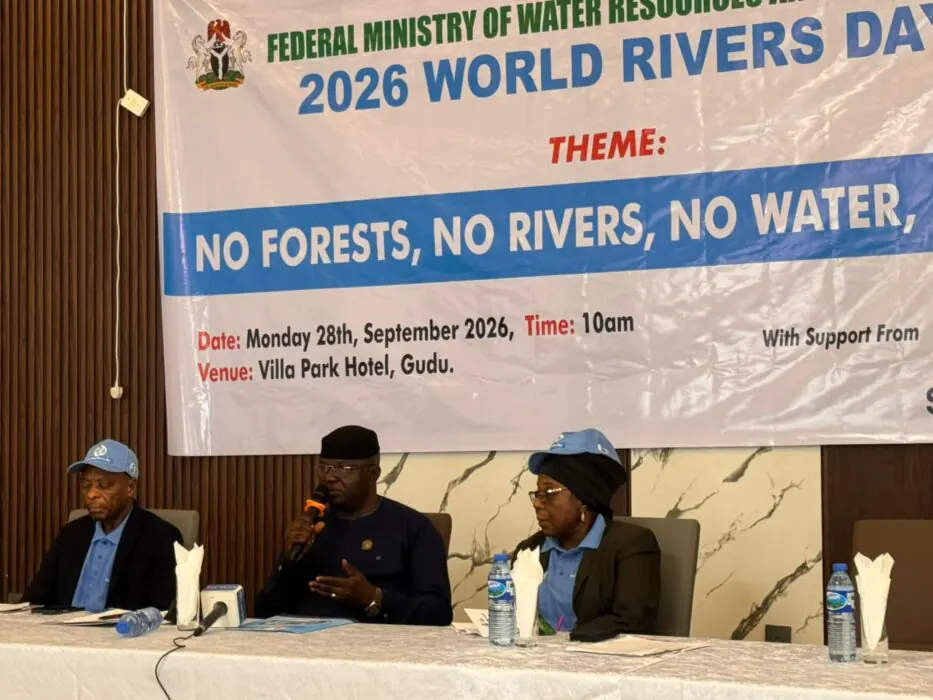
The federal government of Nigeria has expressed concern over the increasing threats to the country's rivers and water resources. According to the Minister of Water Resources and Sanitation, Prof. Joseph Terlumun Utsev, these threats are primarily caused by pollution, climate change, and other human activities. He made this statement during a media briefing in Abuja to mark the 2026 World Rivers Day.
The minister identified several major pressures on Nigeria's rivers, including untreated wastewater, indiscriminate dumping of solid waste, agricultural runoff, erosion, sand mining, population growth, and urbanization. He noted that these challenges are being compounded by climate change, which is causing shifting rainfall patterns, more frequent flooding, and drought. These changes are affecting the country's water resources and ecosystems.
Prof. Utsev emphasized that the threats to Nigeria's rivers require a shift from fragmented management of water resources to an integrated and sustainable approach to managing the country's watersheds and river systems. He stressed that Nigeria's water resources are a shared national heritage and a responsibility that belongs to all citizens. The minister noted that rivers support agriculture, food production, domestic and industrial water supply, fisheries, biodiversity, livelihoods, and economic development.
The minister warned that the degradation of rivers could have severe consequences for communities and ecosystems that depend on them. He highlighted the importance of forests, wetlands, floodplains, and groundwater recharge areas in protecting river sources and regulating water flow. According to him, the degradation of these ecosystems poses significant risks to rivers and the communities that depend on them.
To address these challenges, the ministry is strengthening Integrated Water Resources Management across the country and working with relevant agencies to protect and restore watersheds and river catchments. The government is also strengthening its capacity to collect, analyze, and use data on rainfall, river flows, groundwater, and water quality to support evidence-based water management. These efforts aim to mitigate the impacts of pollution and climate change on Nigeria's rivers.
The minister also emphasized the importance of public health, livelihoods, and water supplies, which are threatened by untreated sewage and wastewater entering rivers. He disclosed that through the federal government's Clean Nigeria Campaign, 179 Local Government Areas have been validated as Open Defecation Free, and over 5,238 public sanitation facilities have been supported nationwide. He urged Nigerians to stop open defecation and indiscriminate dumping of refuse into waterways.
Prof. Utsev called for stronger collaboration among governments, communities, traditional institutions, the private sector, development partners, and civil society to protect Nigeria's rivers. He stressed that activities upstream can have significant consequences for downstream communities and urged young Nigerians to lead efforts against plastic pollution, open defecation, poor wastewater management, and ecosystem degradation. The protection of Nigeria's rivers is a collective responsibility that requires a coordinated effort.
Key points
- The federal government has identified pollution, climate change, and human activities as major threats to Nigeria's rivers and water resources.
- The minister emphasized the need for an integrated and sustainable approach to managing Nigeria's watersheds and river systems.
- The government is working to strengthen Integrated Water Resources Management and protect and restore watersheds and river catchments.