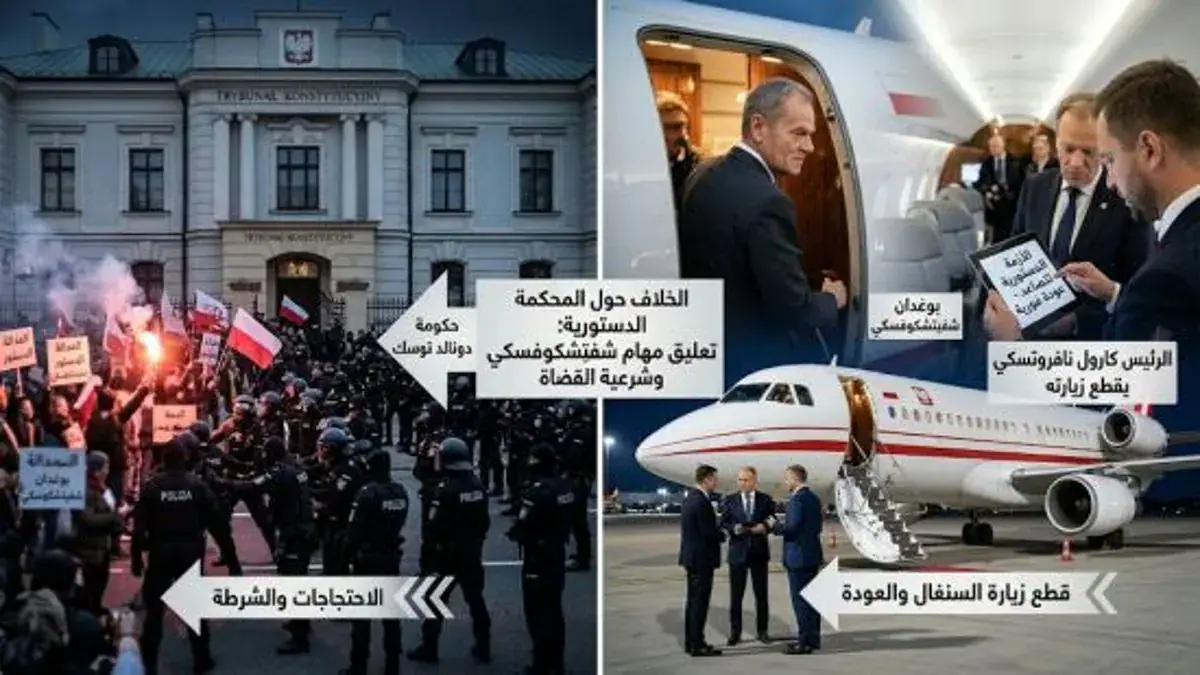
Polish President Karol Nawrotski has cut short his visit to Senegal and returned to Poland due to a deepening constitutional crisis. The crisis centers around the country's top court, with the government and president at odds over the appointment of judges and the court's independence. Nawrotski announced his decision to return on Friday, citing the need for the president to be in Poland during this critical time.
The crisis has its roots in a long-standing dispute between the ruling Law and Justice party and the current government led by Prime Minister Donald Tusk. The government has accused the president and the top court of obstructing the work of newly appointed judges, while the president and his allies argue that the government's actions are an attempt to politicize the judiciary. The dispute has led to a significant escalation of tensions, with police deploying to the area around the top court.
The top court, known as the Constitutional Tribunal, has been at the center of the crisis, with the government and president disagreeing over who has the authority to appoint judges. The court's president, Bogdan Swiczkowsk, has been at the center of the dispute, with the government accusing him of blocking the work of newly appointed judges. In response, the government has requested that Swiczkowsk's immunity be lifted, a move that has been met with fierce resistance from his allies.
The crisis has sparked widespread protests and concerns about the stability of Poland's democratic institutions. The government has argued that its actions are necessary to restore the rule of law and ensure the independence of the judiciary. However, critics argue that the government's moves are an attempt to consolidate power and undermine the country's democratic checks and balances.
The dispute has also raised concerns about the potential for further polarization and instability in Poland. The country's relations with the European Union have been strained in recent years, with Brussels expressing concerns about the government's attempts to reform the judiciary. The crisis has also sparked fears about the potential for further erosion of democratic norms and the rule of law.
Prime Minister Tusk has defended the government's actions, arguing that they are necessary to restore the rule of law and ensure the independence of the judiciary. However, critics argue that the government's moves are an attempt to undermine the country's democratic institutions and consolidate power. The crisis has sparked a wider debate about the future of Poland's democratic institutions and the role of the judiciary.
The crisis is likely to have significant implications for Poland's relations with the European Union and its reputation as a champion of democratic values. The EU has expressed concerns about the government's attempts to reform the judiciary, arguing that they undermine the independence of the courts and the rule of law. The crisis has also sparked fears about the potential for further instability and polarization in Poland.
Key points
- Polish President Karol Nawrotski returns to Poland amid a constitutional crisis and rising tensions over the country's top court.
- The crisis centers around the country's top court, with the government and president at odds over the appointment of judges and the court's independence.
- The dispute has sparked widespread protests and concerns about the stability of Poland's democratic institutions.