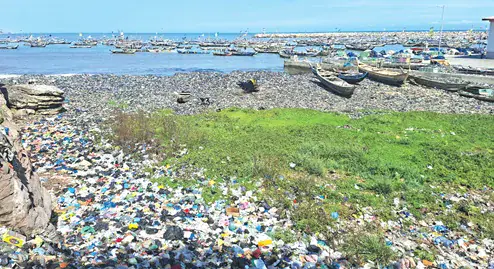
The James Town Fishing Harbour in Ghana has become an open-air landfill, with massive amounts of plastic waste, including polythene, water sachets, and monofilament fishing nets, washing ashore and threatening the livelihoods of hundreds of fishermen, fish processors, and traders. The once-thriving fishing harbour is now stuttering to a halt, with fishermen returning from sea with more plastic than fish. The area's ancestral economic engine is struggling, with plastic pollution depleting fishery stocks at an alarming rate.
Local fishermen, such as 37-year-old Sammy Okine, are frustrated and dejected by the situation, with many having to repair their fishing nets multiple times a week due to the heavy plastic trapped in the water. Daniel Otoo, another fisherman, reported diminishing returns in fishing activities, with barely enough fish to feed their families, let alone turn a profit. The Nae Wulomo, Nuumo Kwaa Mensah III, emphasized that the plastic pollution is not only depleting fish stocks but also robbing the people of their livelihoods.
The crisis facing James Town fishermen is part of a broader national emergency along Ghana's coastline, with the country generating over one million tonnes of plastic waste annually, and less than 10 per cent collected and recycled. According to the United Nations Environment Programme (UNEP), the world produces about 450 million tonnes of plastic waste annually, with poor management of the waste resulting in severe biodiversity loss, ecosystem degradation, and climate vulnerabilities.
The President of the Ghana National Canoe Fishermen Council (GNCFC), Nana Joojo Solomon, noted that the activities of over 140,000 artisanal fishermen across 320 coastal communities in Ghana contribute to plastic pollution, with many fishermen dumping plastic waste into the ocean after drinking water. A study by the Council for Scientific and Industrial Research-Water Research Institute (CSIR-WRI) found that 80-93 per cent of plastic on Ghana's beaches is land-based in origin.
The CSIR-WRI research, made public on August 13, 2026, revealed a high presence of microplastics in local fish, warning that consuming fish gills and guts had health risks. The study found microplastic levels in fish sourced from coastal communities in Accra, including James Town, to be dozens of times higher than internationally recommended safety limits. Dr Pennante Naa Ayikailey Bruce-Vanderpuije, a Senior Research Scientist at CSIR-WRI, described the situation as worrying.
The increasing presence of microplastics in water bodies poses serious risks to human health and the environment, with plastic pollution depleting Ghana's fishing economy while microplastics kill fingerlings and account for up to 20 per cent of net catch volume in some areas. Fish remains a cornerstone of Ghana's nutrition, supplying up to 80 per cent of animal protein intake, making the situation even more alarming.
The dire implications of plastic pollution in Ghana's coastline call for immediate, aggressive global interventions to address the crisis. The Environmental Protection Authority (EPA) and other stakeholders must work together to develop effective waste management strategies and raise awareness about the risks of plastic pollution to mitigate its impacts on coastal livelihoods and the environment.
Key points
- Plastic pollution is depleting fish stocks and threatening the livelihoods of hundreds of fishermen and traders in Ghana's James Town Fishing Harbour.
- Ghana generates over one million tonnes of plastic waste annually, with less than 10 per cent collected and recycled.
- Microplastic levels in fish sourced from coastal communities in Accra are dozens of times higher than internationally recommended safety limits.
Reporting sources
- Plastic-choked beaches: Coastal livelihoods under threat · Daily Graphic