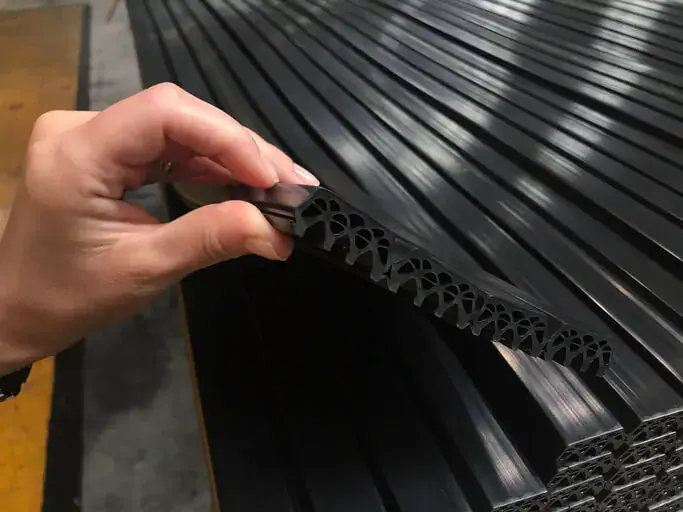
African hardware startups face significant challenges in sourcing long, hollow plastic profiles, a crucial component in many products. While they can quickly prototype electronics, obtaining these plastic components remains a costly and logistical bottleneck. In cities like Nairobi and Lagos, startups can now obtain printed circuit boards, machined housings, and printed packaging within a month. However, product launches often stall when it comes to sourcing these specific plastic components.
The production of long, hollow plastic components, such as cable ducts and window profiles, involves a process called extrusion. This process differs from injection moulding and is typically the last item on the bill of materials to be sourced locally, if a local supplier exists at all. Extrusion offers a lower tooling cost, with a profile die costing only a few thousand dollars, compared to five-figure expenses for an equivalent injection mould. However, this advantage disappears for three-dimensional geometries.
Extrusion works best when the part's cross-section remains constant and its length exceeds roughly four times its width. If the design requires variations in cross-section or complex geometries, secondary operations such as machining or welding are necessary, which erode the cost benefit. Design choices, including wall-thickness uniformity, internal webs, corner radii, and material shrinkage, require careful specification to avoid bowing, twist, or dimensional drift after cooling.
To overcome these challenges, local extrusion capacity must go beyond a basic extruder. It needs in-house die making or a trusted die shop, downstream calibration equipment, and integrated secondary operations such as cutting, punching, and welding. The location of production is also crucial, as extruded profiles are bulky, low-value per kilogram, and prone to damage. Locating production within 500 km of the assembly line can cut freight costs dramatically, provided the die work and downstream processes are available locally.
Founders of hardware startups are advised to design products around constant-section extruded parts, specify realistic tolerances, and incorporate allowances for thermal expansion, UV stabilisation, and seasonal resin variations from the outset. By doing so, they can avoid costly redesigns and ensure a smoother production process. This approach requires careful planning and collaboration with local suppliers to ensure that the necessary components can be sourced efficiently.
The lack of local extrusion capacity and expertise is a significant hurdle for African hardware startups. Many startups in Nairobi and Lagos struggle to find reliable suppliers of long, hollow plastic profiles, which can delay product launches and increase costs. To address this challenge, startups may need to invest in their own extrusion capacity or partner with local suppliers to develop the necessary capabilities.
The issue of plastic extrusion highlights the complexities of hardware production in Africa. While rapid prototyping capabilities have improved significantly, the sourcing of specific components remains a significant challenge. Addressing this challenge will require collaboration between startups, suppliers, and policymakers to develop local capabilities and expertise in extrusion and other critical areas. By doing so, African hardware startups can overcome the hidden hurdles of plastic extrusion and achieve greater success in the market.
Key points
- Local extrusion capacity and expertise are crucial for African hardware startups to overcome the challenges of sourcing long, hollow plastic profiles.
- Designing products around constant-section extruded parts and specifying realistic tolerances can help startups avoid costly redesigns.
- Locating production within 500 km of the assembly line can significantly cut freight costs for extruded profiles.