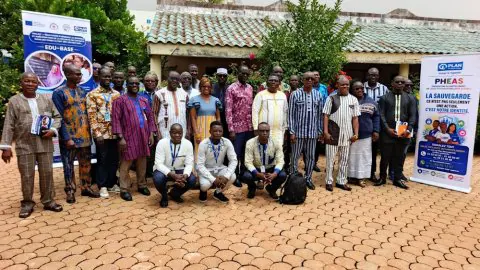
Plan International Burkina Faso has officially launched the "Emergency Education in Burkina Faso and Improved Child Safety in High-Security Challenge Areas" (ÉDU-BASE) project. The launch ceremony took place on September 22, 2026, in Tenkodogo, under the presidency of the governor of the Nakambé region, represented by his secretary general, Tasséré Nacoulma. The project aims to improve access to quality primary education for vulnerable children in a protective environment.
The ÉDU-BASE project was launched in response to the ongoing security and humanitarian crisis in Burkina Faso, which continues to disrupt access to education and child protection mechanisms. According to Plan International Burkina Faso, the crisis has resulted in a significant number of internally displaced children, with 1,749 internally displaced students, including 892 girls, in the Komandjari province. The project will focus on the communes of Gayéri and Ouargaye, where the needs assessment revealed a high level of educational disruption and protection risks for children.
The ÉDU-BASE project will run from July 1, 2026, to July 31, 2028, and is funded by the European Union to the tune of 761,432,478 francs CFA. The initiative targets 12,123 children, with at least 51% being girls, in the two regions of intervention. The project involves setting up 45 accelerated education centers, providing school kits to over 12,000 students, and implementing case management and community protection actions.
The project combines formal and non-formal education, case management, and community protection mechanisms to provide a comprehensive response to the needs of children. According to Plan International Burkina Faso's representative resident, Dr. Ahmed Maïga, education plays a fundamental role in protecting children and vulnerable groups, particularly in emergency situations. The project aims to enable children affected by the crisis to access quality primary education in a safe, inclusive, and protective environment.
The ÉDU-BASE project is a response to the challenges faced by children in the Nakambé and Sirba regions, where the security crisis has resulted in significant disruptions to education and protection mechanisms. The project's approach, which combines education and protection, has been welcomed by local authorities, who see it as a way to improve education and protection indicators in the regions.
The secretary general of the governor of the Nakambé region, Tasséré Nacoulma, has hailed the ÉDU-BASE project as a contribution to the efforts of the authorities to provide resilient education. He noted that the crisis affecting the country since 2016 has put to the test the efforts made to improve access to inclusive and quality education for children.
The ÉDU-BASE project has already started on the ground, with the project team meeting several local actors. Plan International Burkina Faso has thanked its partners for their support and invited them to maintain the momentum to achieve the expected results. The project's success will depend on the engagement of all education and protection stakeholders.
Key points
- The ÉDU-BASE project aims to improve access to quality primary education for 12,123 vulnerable children in Burkina Faso's Nakambé and Sirba regions.
- The project combines formal and non-formal education, case management, and community protection mechanisms to provide a comprehensive response to the needs of children.
- The ÉDU-BASE project is funded by the European Union to the tune of 761,432,478 francs CFA and will run from July 1, 2026, to July 31, 2028.