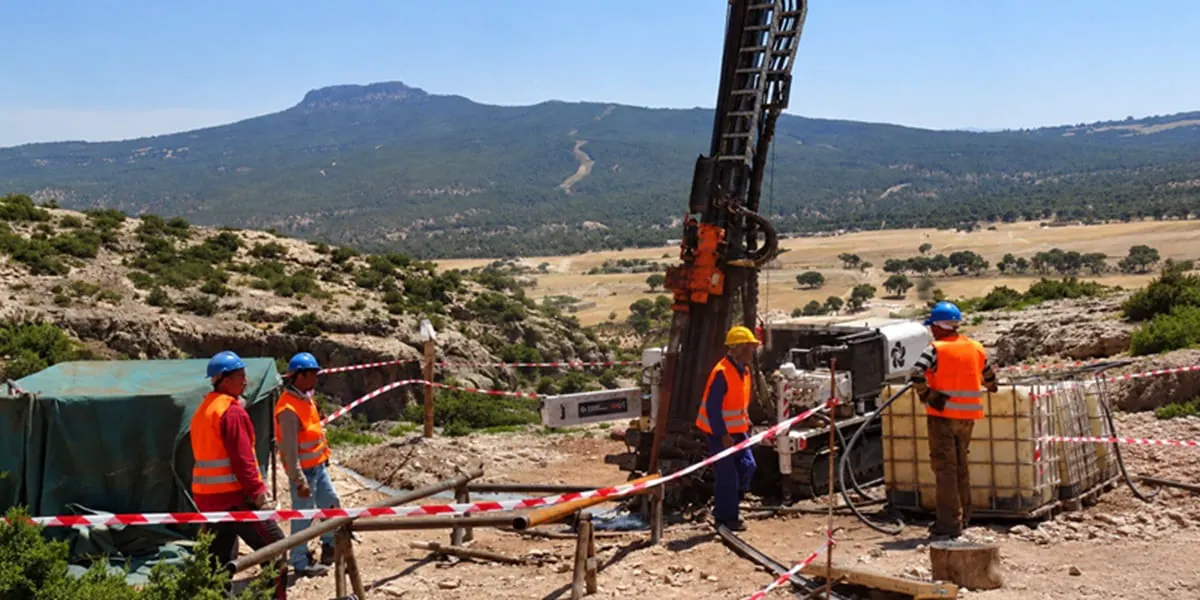
Australian mining company PhosCo has announced a new phosphate discovery in the Rouhia region of Tunisia's Siliana governorate. The discovery was made in the northern part of its Sekarna exploration permit, where two initial drillings encountered phosphate mineralization. According to PhosCo, no prior drilling was known in this specific area, dubbed "Sekarna North". The company's exploration efforts have yielded significant results, with the first drilling intersecting a 6-meter layer of phosphate at a depth of 46.5 meters.
The second drilling, SKDD-2026-02, encountered 7.4 meters of phosphate at a depth of 25 meters. Laboratory analyses are pending to determine the P₂O₅ content of these intersections. PhosCo emphasized that these results should not be considered an estimate of resources or exploitable reserves. Additional drilling will be necessary to determine the extent of the area, its average content, and potential economic interest. The Sekarna permit covers approximately 128 km² in the Rouhia sector.
The Sekarna permit is distinct from PhosCo's Gasaat project, located further southwest. PhosCo has conducted multiple drilling campaigns at Gasaat since 2025, with significant results announced at KM, DOH, and KH. In May 2026, the company reported that its initial resource estimates for KM and SAB had increased Gasaat's declared mineral resources to 166.6 million tons, with an average content of 20.6% P₂O₅.
The discovery in Rouhia expands PhosCo's exploration efforts to another phosphate permit, rather than being a direct extension of Gasaat. The company's announcement also included new drilling results at DOH, where two additional drillings encountered 8.1 meters and 9 meters of phosphate mineralization. Laboratory analyses are pending for these results as well.
PhosCo's ongoing exploration program in Tunisia's phosphate basin has yielded encouraging results. The company's efforts at Gasaat and now Sekarna North demonstrate its commitment to expanding its presence in the region. At Rouhia, the primary challenge will be confirming whether the initial results at Sekarna North can be replicated over a sufficiently large area to enable PhosCo to establish an initial resource estimate.
The Tunisian government has been actively promoting phosphate mining, with international partners showing interest in the sector. In May 2026, the US government expressed interest in mobilizing $100 million for phosphate mining in Tunisia, with China also involved in the country's mining sector.
PhosCo's discovery in Rouhia has significant implications for the company's future operations in Tunisia. The company's shares rose following the announcement, reflecting investor optimism about the potential for further discoveries in the region. As PhosCo continues its exploration efforts, it will be closely watched by industry analysts and investors alike.
Key points
- PhosCo announces new phosphate discovery in Tunisia's Rouhia region
- The discovery was made in the northern part of its Sekarna exploration permit
- The company's exploration efforts have yielded significant results, with pending laboratory analyses to determine P₂O₅ content