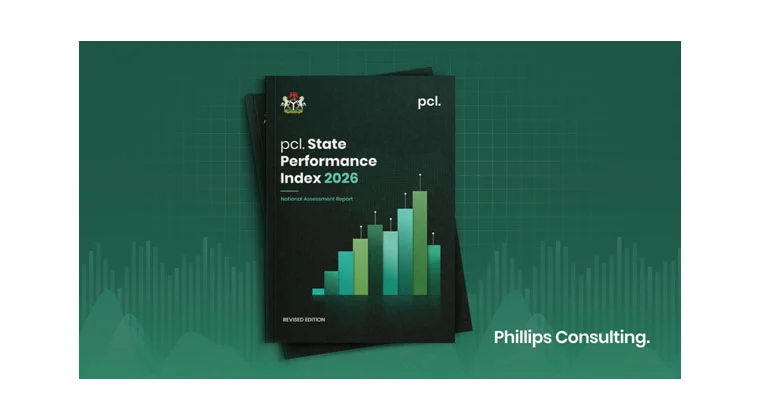
Phillips Consulting Limited (pcl.) has released a revised edition of its 2026 State Performance Index (pSPI), which incorporates newly available financial data and strengthens the methodology used to assess state performance across Nigeria. This revised edition supersedes the initial 2026 pSPI released on July 23, 2026. The revision reflects pcl.'s commitment to ensuring its research remains grounded in the most current and robust evidence available.
The initial 2026 edition was developed using financial year 2024 audited financial statements, which were the most recent available at the time. Following the release of financial year 2025 audited accounts, pcl. undertook a detailed review of the Index to incorporate the newer financial data and further strengthen the methodology and interpretation of results. This edition presents the revised results after a detailed audit and recalculation of the initial findings.
The revised 2026 pSPI introduces several methodological improvements to provide a clearer view of state performance. It separates the measurement of current performance from the measurement of performance trajectory. A Performance Snapshot shows where each state currently stands, while the Rank Trajectory shows how its position has changed across the 2024, 2025, and 2026 editions. Movement is now measured by change in performance rank rather than differences in scores.
The financial assessment in the revised Index has been updated to use financial year 2025 audited accounts, replacing the financial year 2024 figures used in the initial 2026 edition. In assessing debt sustainability, the revised methodology considers both debt per capita and debt relative to state revenue, providing a more balanced view of state indebtedness. The Index also strengthens its assessment of financial transparency by evaluating the date on which each state published its audited accounts relative to the statutory deadline.
According to Foluso Phillips, Chairman of Phillips Consulting, credible research requires more than publishing findings; it demands the discipline to interrogate the evidence behind those findings. The revision reinforces the value of the Index to stakeholders who rely on it to understand Nigeria's subnational performance landscape. Olawanle Moronkeji, Chief Operating Officer of Phillips Consulting, stated that the revised edition gives stakeholders a clearer lens for making distinctions and extracting more meaningful insight from the Index.
Victor Mba, Senior Managing Consultant at Phillips Consulting, highlighted the technical rationale behind the changes, noting that the revised methodology makes an important distinction between performance at a point in time and movement over time. The changes improve how the results can be interpreted and reduce the risk of treating differences in data scales or data availability as differences in state performance. The revised 2026 pSPI does not alter the purpose of the Index or the importance of measuring state performance through multiple dimensions.
The revised 2026 pcl. State Performance Index is available at www.pspi.com.ng. As part of the changes, pcl. is establishing a new publication cycle for the pSPI, which will be published after July 31st each year, allowing the assessment to draw on audited financial statements for the immediately preceding financial year. This change aims to provide a more consistent and complete evidence base for future editions, supporting better decision-making across Nigeria's public and private sectors.
Key points
- The revised 2026 pSPI incorporates newly available financial year 2025 audited financial statements and strengthens its methodology to provide a clearer view of state performance.
- The revised Index separates the measurement of current performance from the measurement of performance trajectory, providing a more balanced view of state performance and indebtedness.
- The new publication cycle for the pSPI will ensure that future editions are based on the most current and robust evidence available.