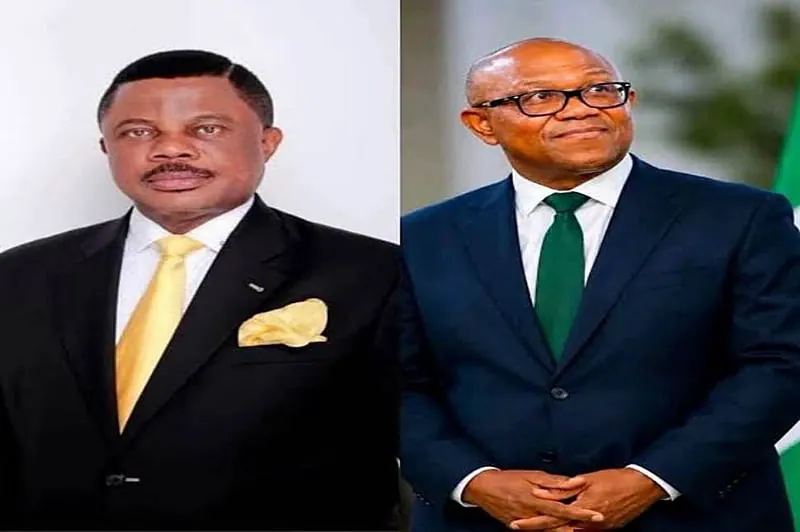
The controversy surrounding the handover of Anambra State's administration from Peter Obi to Willie Obiano in March 2014 has sparked heated debates. The current governor, Charles Soludo, and Peter Obi have been at odds over the state's financial position during the handover. A document dated March 17, 2014, summarized the state's financial position, revealing ₦27 billion in local investments, ₦26.5 billion in foreign-currency investments, and ₦28.166 billion in certified balances.
The document recorded a "net balance" of ₦86.666 billion, which is substantially higher than the ₦35.5 billion that Willie Obiano later claimed he inherited in cash and near-cash assets. The ₦27 billion classified as local investments represented investments made by the state, not simply money sitting idly in a government bank account. Similarly, the US$156 million foreign-currency investment was an investment portfolio rather than ordinary naira cash.
The handover documentation revealed that the foreign-currency investments included holdings connected to sovereign and other investment instruments. Some of these investments could generate income, but their existence did not necessarily mean that an incoming governor could immediately spend the entire amount on recurrent government expenditure. The ₦28.166 billion in certified State and MDAs balances was spread across a number of accounts and purposes.
The balances included the State Cash Book, State Subsidy, Ecological Funds, Special Projects, Local Government SURE-P, JAAC, Fidelity balances, Set-Aside Accounts, Works, Youth and Sports, and other specified accounts. There was also approximately ₦2.1 billion in unutilized Universal Basic Education-related funds. The existence of these balances demonstrated that the state had substantial financial resources, but some of the money was earmarked for particular programmes and purposes.
A government can possess substantial assets without having an equivalent amount of unrestricted cash available for any purpose its successor chooses. For example, money invested in securities is different from money in a current account. A Federal Government refund is different from internally generated revenue. Funds earmarked for education, ecological programmes, or other statutory purposes cannot necessarily be treated as though they were unrestricted operating cash.
In 2015, the Obiano administration challenged the widely circulated claim that Obi had handed over more than ₦75 billion in readily usable funds. The administration stated that the "actual and voluntary cash investments" inherited from the previous administration amounted to approximately ₦35.5 billion. The explanation put about ₦9 billion in cash and roughly ₦26 billion in investments or near-cash assets.
The dispute highlights the complexities of government finance and the need for transparency in the handover of power. The controversy has sparked reactions from various quarters, with many condemning Soludo's attempts to discredit Peter Obi. As the debate continues, the focus should be on the financial statement contained in the 2014 handover document, which provides a detailed picture of the state's financial position at the time of the handover.
Key points
- The handover document recorded a "net balance" of ₦86.666 billion, which is substantially higher than the ₦35.5 billion that Willie Obiano later claimed he inherited.