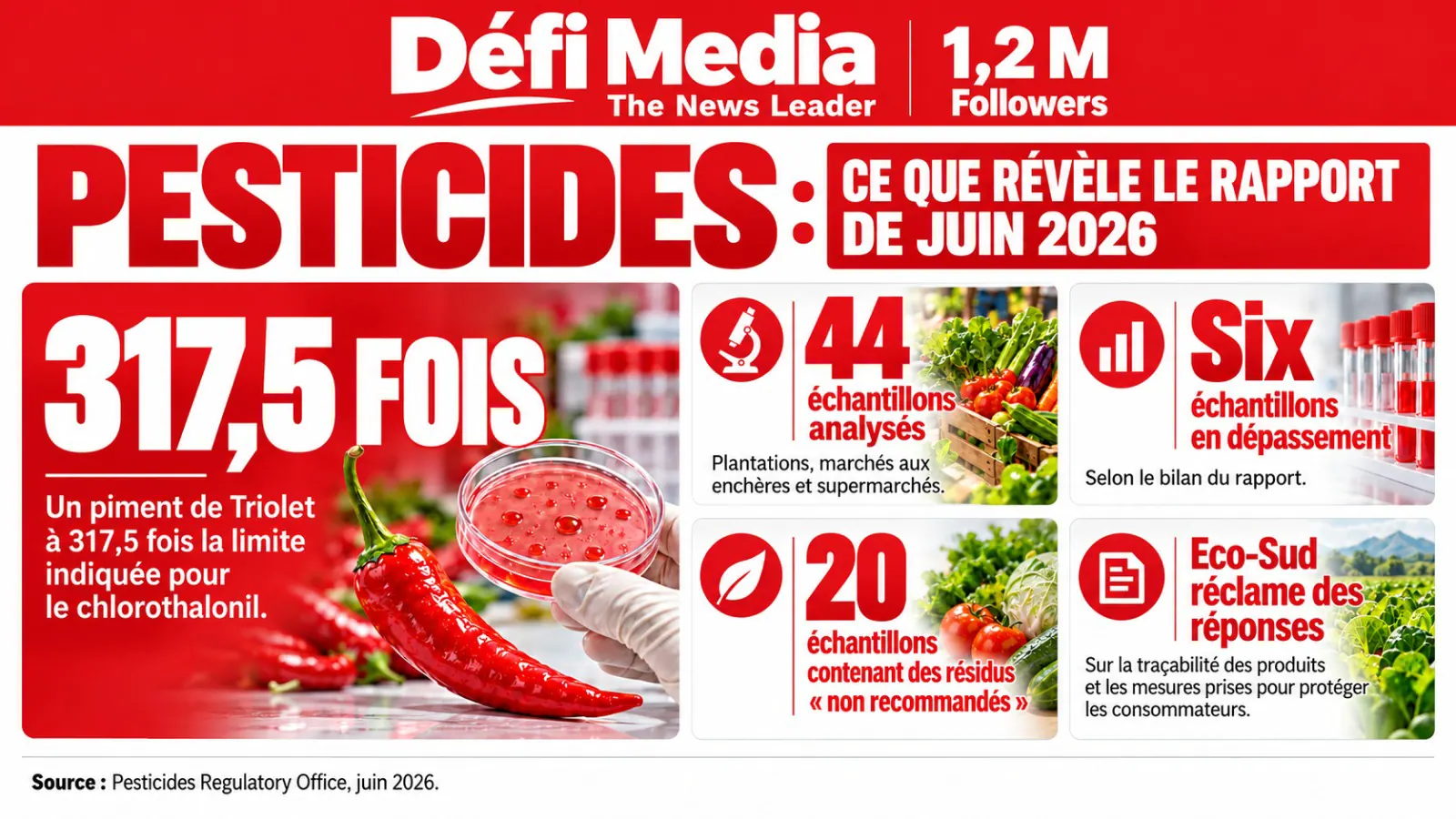
A report by the Pesticides Regulatory Office in Mauritius has found that several samples of fruits and vegetables contain pesticide residues that exceed safe limits. The report, which analyzed 44 samples of produce, found that six samples had residues that surpassed the maximum limits, while 20 samples contained residues that were not recommended. One sample of chili pepper from Triolet had a residue level 317.5 times higher than the recommended limit.
The samples were collected from various sources, including plantations, markets, and supermarkets. The report noted that the sample with the highest residue level was a chili pepper from Triolet, which contained 3.175 mg/kg of chlorothalonil, a pesticide commonly used to control fungal diseases. Other samples that exceeded safe limits included chili peppers from Calodyne and Morcellement Saint-André, an pineapple from Caroline, a lalo from Quatre-Bornes, and a cabbage from Vacoas.
The report also noted that some samples contained residues that were not recommended, but did not exceed safe limits. For example, a lettuce sample from Dagotière contained residues of phosphonic acid, but the level was not quantified. The report's findings have raised concerns over food safety and the use of pesticides in Mauritian agriculture. The environmental organization Eco-Sud has called for greater transparency and action from authorities to address the issue.
Eco-Sud has questioned the regulatory framework for pesticide use in Mauritius and called for more stringent controls. The organization has also asked for information on the procedures for monitoring and enforcing pesticide use, as well as the consequences for farmers who exceed safe limits. Furthermore, Eco-Sud has urged authorities to support farmers in adopting more sustainable agricultural practices that reduce the use of pesticides.
The Mauritian government has responded to the report's findings by announcing plans to strengthen regulations on pesticide use. The Minister of Agro-industry, Arvin Boolell, has stated that the government will increase public awareness and education on safe pesticide use, as well as provide training and support for farmers. The government is also reviewing four draft regulations that aim to improve pesticide management and enforcement.
The issue of pesticide residues in Mauritian produce has also raised concerns over environmental impact. The Junior Minister of Agro-industry, Fabrice David, has highlighted the potential risks of pesticide use on water, soil, and biodiversity. A committee interministerial has been examining the issue of pesticide use in Mauritius and its potential consequences for human health and the environment.
The Mauritian government has committed to implementing new regulations and guidelines to address the issue of pesticide residues in produce. The regulations, which are expected to come into effect by the end of November 2026, aim to improve pesticide management, enforcement, and education. The government has also encouraged farmers to adopt more sustainable agricultural practices, including the use of biopesticides and organic farming methods.
Key points
- The report found that one sample of chili pepper had a pesticide residue level 317.5 times higher than the recommended limit.
- The Mauritian government has announced plans to strengthen regulations on pesticide use and provide training and support for farmers.
- The issue of pesticide residues in Mauritian produce has raised concerns over food safety, environmental impact, and the need for more sustainable agricultural practices.