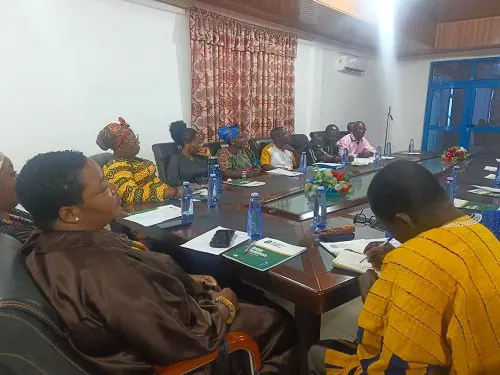
The Eastern Regional Peace Council recently organized a capacity-building program for traditional leaders and local government officials in the Akuapem Adonten Division of Ghana. The program, held at Aburi in the Eastern Region, aimed to strengthen traditional and local governance systems and promote sustainable peace. About 200 participants attended the event, which focused on enhancing their skills in dispute resolution. The program was themed "Strengthening Traditional and Local Governance Systems."
The training covered various topics, including customary law and statutory provisions relating to case adjudication, principles of natural justice in traditional adjudication, customary arbitration, and traditional governance and contemporary leadership. The program was informed by the Council's 2025 Regional Peace Index, which identified chieftaincy disputes as a major source of conflict in the region. According to the index, about 61 percent of conflict issues recorded in the region were related to chieftaincy, followed by land disputes.
The Chairman of the Eastern Regional Peace Council, Dr. Mark Boadu, emphasized the importance of building the capacity of traditional leaders to enable them to better understand contemporary governance, legal requirements, and effective dispute resolution methods. He noted that the program aimed to equip traditional leaders with the knowledge and skills to adjudicate cases fairly and transparently, reducing the number of disputes that end up in formal courts. Dr. Boadu said this would promote greater transparency and accountability within traditional institutions and strengthen public confidence in their decisions.
A resource person, Lawyer Alex Nartey, highlighted the critical role chiefs play in Ghana's governance system, particularly in adjudication, customary arbitration, and mediation. He emphasized the need for traditional leaders to understand the legal principles governing their adjudicatory functions to ensure their decisions are respected and sustained. Lawyer Nartey urged chiefs to observe the principles of natural justice, including fair hearing and neutrality, and avoid conflicts of interest when adjudicating cases.
The Council also introduced a self-assessment and governance assessment exercise, which will enable participants to identify governance gaps and develop action plans to improve governance in their respective communities. This initiative is expected to enhance access to justice at traditional councils and palaces and encourage disputing parties to use traditional dispute-resolution mechanisms. The program is the second of its kind, following an earlier one held at Akwamufie.
The Municipal Chief Executive (MCE) of the Akuapem South Municipality, Mr. Paul Osae Offer, acknowledged the need for the training, citing the numerous land disputes in the Akuapem Adonten Division, many of which involve lands vested in traditional authorities. He emphasized that the training would equip traditional leaders with the requisite knowledge and skills to adjudicate such cases and resolve them fairly. The program is expected to have a positive impact on dispute resolution in the region.
The Eastern Regional Peace Council's initiative is a step towards promoting sustainable peace and strengthening traditional and local governance systems in Ghana. The program has provided traditional leaders and local government officials with the necessary tools to resolve disputes effectively, promoting transparency and accountability within traditional institutions. The Council's efforts are expected to reduce the number of disputes that end up in formal courts and enhance access to justice at traditional councils and palaces.
Key points
- The Eastern Regional Peace Council trains traditional leaders and officials to strengthen traditional and local governance systems.
- The program aims to promote sustainable peace and reduce disputes that end up in formal courts.
- The training covers topics such as customary law, statutory provisions, and principles of natural justice in traditional adjudication.