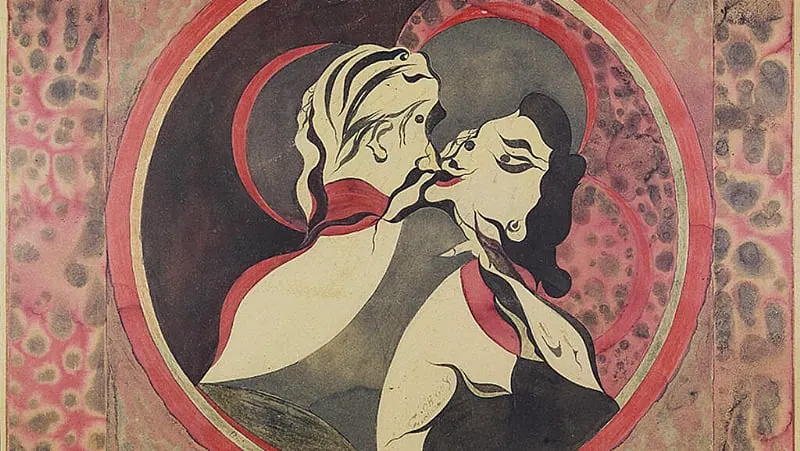
The Sainte-Anne hospital in Paris is home to a unique art collection that challenges the long-held myth of the "mad genius." The collection, which features 145 drawings and paintings created by psychiatric patients between 1858 and 2020, offers a window into the changing attitudes towards art and mental illness over the years. The exhibition, which runs until December 20, brings together works that were once viewed solely through the lens of their creators' illnesses.
For much of history, artworks created by psychiatric patients were treated as medical records rather than art. In 1900, London's Bethlem Royal Hospital held an exhibition of 600 pieces, which were mainly viewed as curiosities. However, as the artistic qualities of these works gained attention, they were sometimes attributed to a supposed lack of inhibition among patients. The Sainte-Anne collection tells a different story, valuing the artistic qualities of the works as well as studying them from a psychiatric perspective.
The idea that mental illness is linked to creativity has been questioned by many experts. Anne-Marie Dubois, a psychiatrist and scientific director of the Museum of Art and History of Sainte-Anne Hospital, argues that this notion goes beyond scientific evidence and persists despite evidence to the contrary. According to Dubois, what matters in certain cases is a particular relationship with reality, rather than a supposed lack of inhibition.
The collection features works by artists who were already established before their hospitalization, such as German artist and writer Unica Zürn. Zürn spent time at Sainte-Anne in the early 1960s and produced many works during her stay, which were rooted in the artistic movements of her time. Dubois emphasizes that a patient cannot be reduced to their illness, and that their work should be viewed as part of a shared human experience.
The museum's main collection contains around 2,000 works, including pieces produced by doctors and artists who took part in exhibitions at Sainte-Anne. A further 50,000 works produced during art workshops at the hospital after World War II are not on public display but are kept for researchers. The museum's approach is part of a continuing effort to fight stigma and recognize the artistic value of the works.
Sainte-Anne has a long history of providing psychiatric care and promoting artistic creation. The hospital opened as a clinical asylum in 1867 and became a place of culture and artistic creation in the 1930s, with psychiatrists and psychoanalysts coming into contact with artists linked to the surrealist movement. The hospital hosted its first exhibition of work by patients in 1946, and four years later, it hosted the first World Congress of Psychiatry, which brought together 2,000 works from 17 countries.
The Sainte-Anne collection has gained recognition in recent years, with the museum being granted official status as a national museum in 2016. This has given the collection legal protection, and two rooms at Sainte-Anne are now used for temporary exhibitions. The current exhibition, "Masterpieces: At the Heart of the Sainte-Anne Collection," showcases some of the most remarkable works in the collection, offering a unique perspective on the complex relationship between art and mental illness.
Key points
- The Sainte-Anne hospital's art collection challenges the myth of the "mad genius" by showcasing artworks by psychiatric patients as valuable contributions to the art world.
- The collection features 145 artworks created by patients between 1858 and 2020, offering a window into changing attitudes towards art and mental illness.
- The museum's approach is part of a continuing effort to fight stigma and recognize the artistic value of the works, promoting a more nuanced understanding of the relationship between art and mental illness.