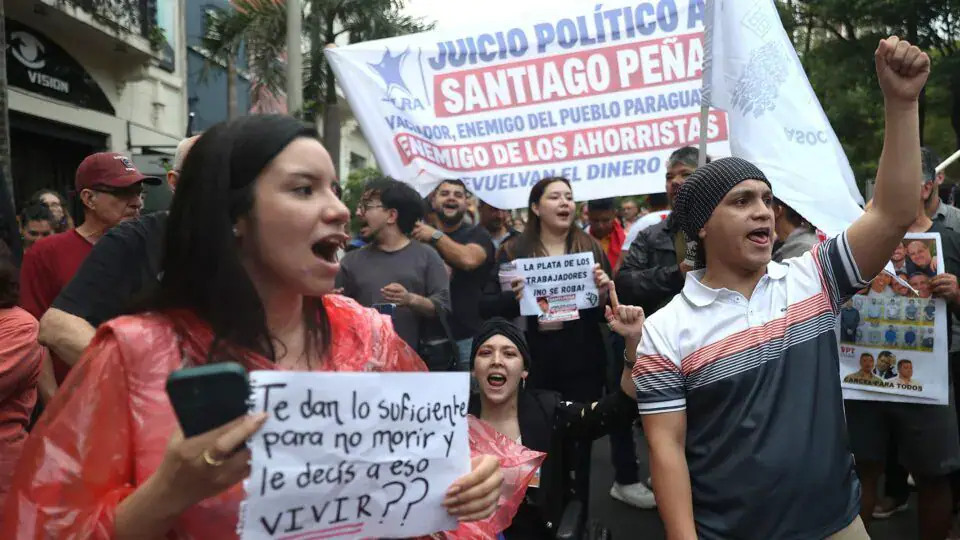
Paraguayan President Santiago Peña announced his resignation on Friday, November 6, 2026, amid intense pressure over the collapse of Banco Ueno, a bank to which he has ties. Peña, an ally of former US President Donald Trump and a prominent figure in South American right-wing politics, stated that he would cooperate fully with the authorities to clarify the circumstances surrounding the bank's collapse and determine those responsible. He promised to exercise his right to defense in the upcoming political trial in the Senate.
The crisis began when the Banco Central del Paraguay (BCP) ordered the resolution process against Banco Ueno, citing a solvency index that had fallen below 50% of the required minimum. This was due to adjustments made to the bank's financial statements during the regularization process. The bank's collapse affected nearly half of Paraguay's population and several state entities, with 2.9 million clients in a country of 6.1 million inhabitants.
Despite his resignation, Peña remains formally in office as the legislature failed to achieve a quorum for a joint session to vote on his removal. This development delayed the activation of the succession mechanism, which would have allowed for a transfer of power. Peña assured that he would make available all the information requested by the authorities and emphasized that payments to savers should not be contingent on his continuity in office.
The President's announcement came after the Chamber of Deputies unanimously approved the accusation to submit Peña to a political trial, making him the second head of state to face such a process in Paraguay's recent history, following former President Fernando Lugo. The trial is set to proceed in two phases: the recognition of deputies as accusing prosecutors and the swearing-in of senators to constitute the judging tribunal.
Peña's decision to resign and face a political trial was influenced by the severe impact of the banking crisis on the Paraguayan population and economy. With many citizens' funds frozen, the government faces pressure to find a swift resolution to the crisis. Peña's cooperation with the authorities is seen as a crucial step towards addressing the situation and restoring stability to the financial system.
The Senate President, Basilio Núñez, confirmed that a new plenary session would be convened to continue the trial of the President. The session would focus on the recognition of deputies as accusing prosecutors and the constitution of the judging tribunal. This development marks a significant step towards holding Peña accountable for his role in the banking crisis.
As the trial proceeds, Peña's future in politics remains uncertain. His resignation and decision to face a political trial may have implications for his legacy and the trajectory of his political career. The outcome of the trial will likely have far-reaching consequences for Paraguay's politics and economy, and may shape the country's approach to addressing financial crises in the future.
Key points
- Paraguayan President Santiago Peña has resigned amid a banking crisis triggered by the collapse of Banco Ueno, to which he is linked.
Reporting sources
- Presidente do Paraguai demite-se e promete aceitar... · novojornal.co.ao