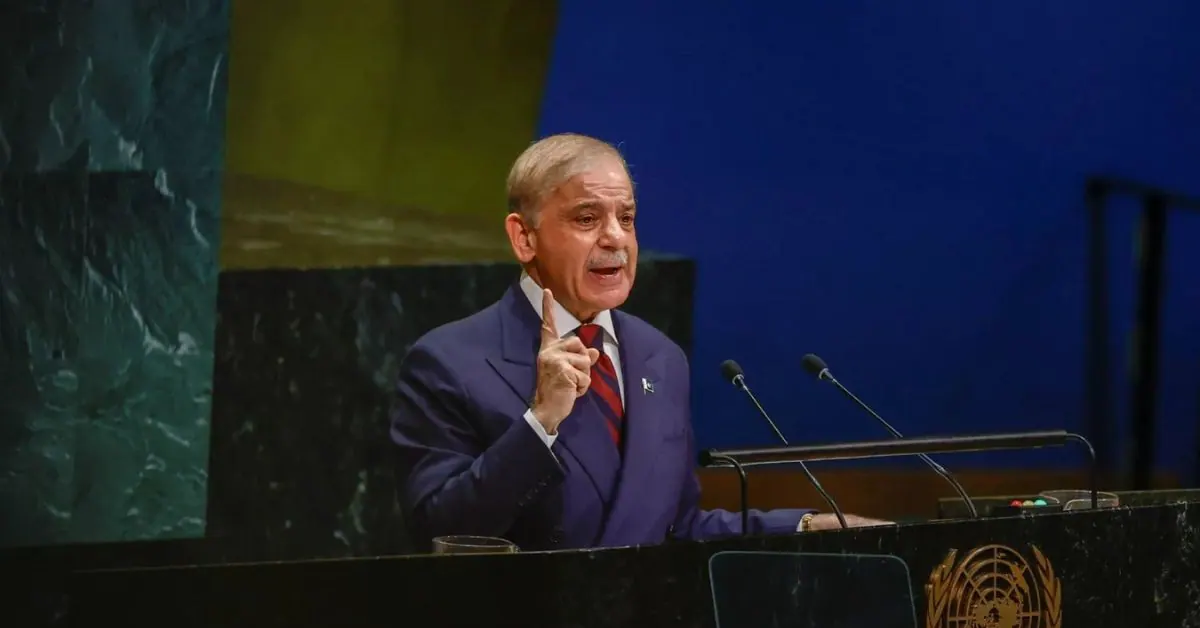
Pakistan Prime Minister Muhammad Shehbaz Sharif addressed the 81st session of the United Nations General Assembly in New York, emphasizing that the security of the holy sites in Saudi Arabia is a 'red line' for his country. He reiterated Pakistan's condemnation of recent attacks targeting Saudi Arabia. Sharif's statement underscores Pakistan's commitment to regional stability and security.
During his speech, Sharif highlighted the significance of the 'Makkah Agreement for Joint Defense' between Saudi Arabia, Turkey, and Pakistan. He clarified that this agreement is not aimed at any specific country but rather seeks to promote peace and stability in the region. The agreement reflects the collective efforts of these nations to ensure security and cooperation.
The Prime Minister of Pakistan expressed concern over the escalating conflicts in the Middle East, which have adversely affected global trade and economies. He stressed the importance of keeping vital sea lanes, such as the Strait of Hormuz and the Bab-el-Mandeb, open for international trade. This, he believes, is crucial for maintaining global economic stability.
On the issue of Palestine, Sharif reaffirmed Pakistan's support for an independent Palestinian state based on the 1967 borders. He criticized the forced displacement of Palestinians, describing it as part of a broader agenda aimed at committing genocide. Sharif also condemned military operations by Israeli forces in Palestinian territories, Lebanon, and Syria.
Sharif's address to the UN General Assembly reflects Pakistan's active role in promoting peace and stability in the region. His statements on the security of holy sites, regional conflicts, and the Palestinian issue highlight Pakistan's commitment to addressing pressing global concerns. The international community is closely watching Pakistan's stance on these critical issues.
Pakistan's relations with Saudi Arabia are particularly significant, given their historical and cultural ties. Sharif's emphasis on the security of holy sites in Saudi Arabia underscores the importance of this bilateral relationship. The two countries have traditionally enjoyed strong diplomatic and economic ties, with Saudi Arabia being a key player in Pakistan's energy and economic sectors.
The international community has welcomed Pakistan's stance on regional security and global issues. Sharif's address to the UN General Assembly has been seen as a reaffirmation of Pakistan's commitment to peace, stability, and cooperation. The Prime Minister's call for a peaceful resolution to regional conflicts and his emphasis on the security of holy sites are expected to resonate with the international community.
Key points
- Pakistan Prime Minister Muhammad Shehbaz Sharif emphasizes that the security of holy sites in Saudi Arabia is a 'red line' for his country.