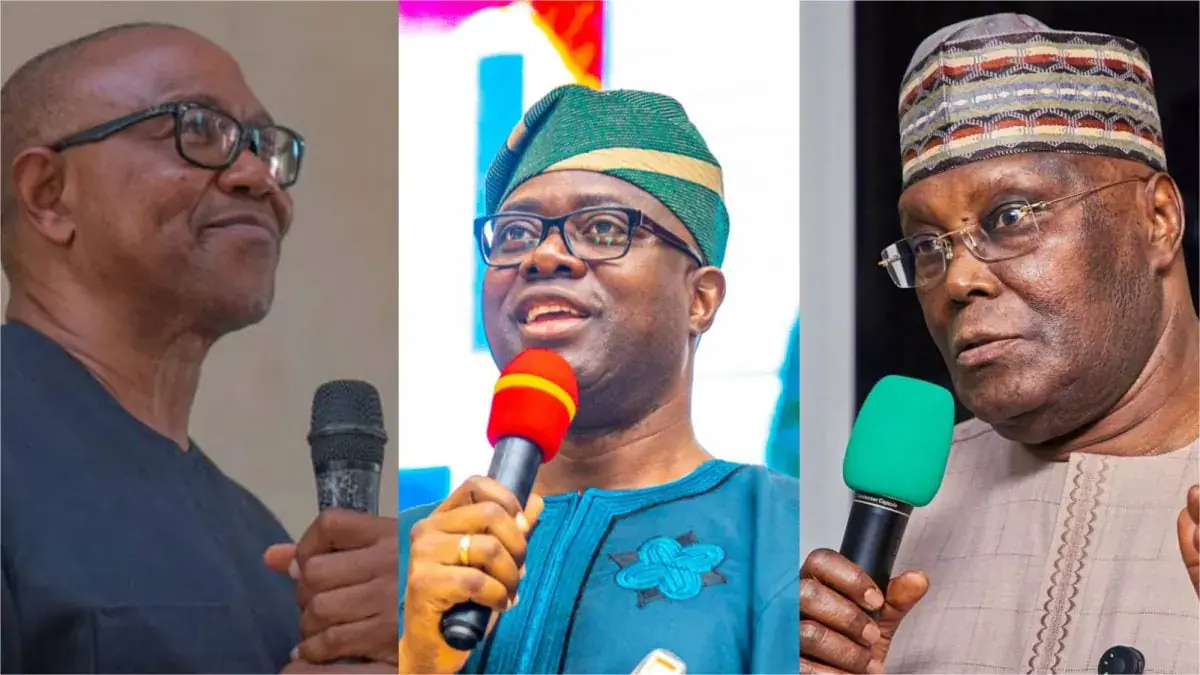
Oyo State Governor Seyi Makinde has disclosed the reasons behind the decision of the five aggrieved governors of the Peoples Democratic Party (PDP), popularly known as the G5, to reject former Vice-President Atiku Abubakar and Labour Party presidential candidate Peter Obi during the 2023 general election. According to Makinde, the decision was influenced by disagreements over the PDP's zoning arrangement and concerns about the concentration of political power in the hands of northern leaders.
The G5 governors, comprising Makinde, former Rivers State Governor Nyesom Wike, former Benue State Governor Samuel Ortom, former Abia State Governor Okezie Ikpeazu, and former Enugu State Governor Ifeanyi Ugwuanyi, were uncomfortable with the party's decision to leave its presidential ticket open after eight years of President Muhammadu Buhari's administration, led by a northerner. Makinde explained that the group had pushed for the presidency to move to the South in the interest of fairness and political balance.
Makinde revealed that the G5 governors held discussions with Atiku and presented several conditions they believed would address their concerns about political representation and the future structure of the party. However, their objections concerned the positions occupied by key northern politicians within the PDP's leadership and presidential campaign, including Atiku as the presidential candidate, Senator Iyorchia Ayu as the party's national chairman, and former Sokoto State Governor Aminu Tambuwal as Director-General of the presidential campaign.
The governor argued that the arrangement gave three northern politicians considerable influence over the party's presidential campaign and the decisions that could shape the next administration. He said the governors wanted a political structure that would give the South a meaningful role in decision-making rather than simply expecting southern politicians to support the party without adequate representation.
The disagreement eventually pushed the G5 to consider political alternatives outside the PDP, particularly as the group was determined to secure certain commitments on how the country would be governed after the election. Makinde disclosed that the governors approached both Peter Obi and Bola Tinubu, who was then the presidential candidate of the All Progressives Congress (APC), to discuss their expectations for the country.
Makinde said the discussions centred on the possibility of establishing a government of national unity that would accommodate different interests and ensure that Nigerians from all parts of the country had a sense of belonging. The governor explained that the group wanted assurances that the next government would not concentrate opportunities and political appointments in the hands of a few individuals or a particular section of the country.
According to Makinde, Tinubu's response influenced their eventual decision to support the APC presidential candidate instead of Atiku or Obi. He also acknowledged that the G5 had taken a significant political risk by openly challenging Atiku's candidacy and demanding the resignation of the PDP National Chairman, Senator Iyorchia Ayu.
Key points
- The G5 governors rejected Atiku Abubakar and Peter Obi due to disagreements over PDP's zoning arrangement and concerns about concentration of power in northern leaders.
Reporting sources
- Why G5 Governors Rejected Atiku, Obi in 2023 – Makinde Reveals · Politics Nigeria