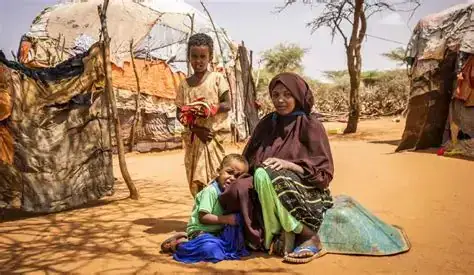
According to the World Bank's Poverty, Prosperity, and Planet Report, 811 million people worldwide live in extreme poverty, defined as surviving on less than $3.00 a day. This number has remained steady since 2019, with 1 in 10 people struggling to meet basic needs. The report highlights that over half of those living in extreme poverty reside in nine economies.
The World Bank warns that without stronger per capita growth, the number of people in extreme poverty is projected to be higher in 2030 than it is today. Despite progress in reducing extreme poverty over the past decades, many individuals remain vulnerable to falling back into poverty. Nearly half of humanity, 3.7 billion people, live on less than $8.30 a day, with most being one shock away from extreme poverty.
Climate-related shocks pose a significant threat to progress against poverty. With 4.6 billion people living in areas exposed to major climate-related hazards, over a billion are highly vulnerable due to a lack of social protection or access to basic infrastructure. Although the high-risk share declined from 1 in 3 people in 2010 to 1 in 6 people in 2024, the number of people exposed rose by about 550 million.
The report emphasizes that efforts to eradicate extreme poverty would have a minimal impact on global emissions, estimated to add less than 5%. The extreme poor contribute the least to global emissions but are the most vulnerable to climate change consequences. Employment, both in quantity and quality, is crucial for poverty reduction, as nearly all poor households rely on human capital as their primary productive asset.
To reduce poverty, the World Bank suggests that closing employment gaps in poor households could decrease extreme poverty by a fifth. Additionally, raising the earnings of poor workers toward those of comparable non-poor workers could cut poverty by nearly half. The report also notes that someone born in their 70s today witnessed six out of ten people living in extreme poverty globally at birth, compared to 1 in 10 today.
The world has made significant progress in reducing extreme poverty over the past 75 years, from 60% in 1950 to 10% in 2025. However, this progress has stalled in the last decade due to various crises, including the COVID-19 pandemic, climate-related shocks, and geopolitical tensions. Sub-Saharan Africa and the Middle East and North Africa have driven this stagnation.
The report concludes that economic growth in Sub-Saharan Africa has been insufficient to compensate for high population growth, leading to a slow recovery from global shocks. The region is expected to host 87% of the extreme poor by 2030, primarily in fragile and conflict-affected situations.
Key points
- The World Bank's report emphasizes the need for stronger per capita growth and improved employment opportunities to reduce extreme poverty.
- Climate-related shocks pose a significant threat to progress against poverty, with over a billion people highly vulnerable due to a lack of social protection or access to basic infrastructure.
- The effort to eradicate extreme poverty is estimated to add less than 5% to global emissions, highlighting the minimal environmental impact of poverty reduction efforts.