A healthcare project implemented in Burkina Faso's Nando and Guiriko regions has concluded after three years, achieving significant milestones in improving healthcare access and infrastructure. The project, funded by the European Union with €4.3 million, was carried out by a consortium of Médecins du Monde France, Help, and the Burkinabé Red Cross. Its primary goal was to enhance primary healthcare services for vulnerable populations.
The project focused on capacity building for healthcare facilities, improving access to care, and developing community-based interventions. Eight healthcare facilities received equipment, infrastructure, and hygiene materials, while healthcare workers received training and essential medicines were provided. The project's impact was evident in the upgrade of the Réo surgical center, which received an operating table and anesthesia equipment.
The project also supported the free healthcare policy for children under five and pregnant women, providing essential medicines and rehabilitating maternity and hospitalization units. Furthermore, it facilitated supervision activities, consultations on referrals and counter-referrals, and maternal death audits. The project's community-based approach involved training community health workers to provide care to children, resulting in 27,362 children receiving care, exceeding the initial target of 18,000.
In addition to infrastructure and equipment upgrades, the project engaged communities through health education and awareness campaigns, reaching 96,443 people. A community-based surveillance mechanism was established, enabling the reporting of 2,108 difficulties in accessing care, of which 1,784 were resolved. This mechanism allowed communities to voice their concerns and contribute to finding solutions to healthcare challenges.
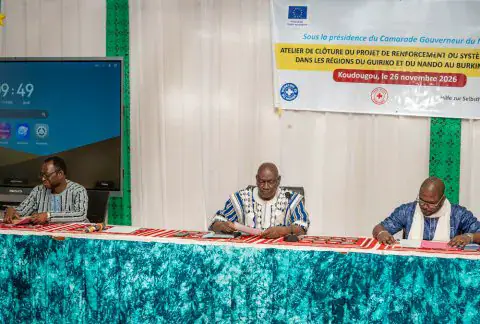
The project's closure event, held on November 26, 2026, in Koudougou, marked the handover of an ambulance to the Koudougou health district, enhancing emergency response and patient transfer capabilities. The project's coordinator, Issouf Maïga, reported a 99.50% physical implementation rate and 98% financial execution rate. The regional health director, Dr. Mohamed Karl Anicet Kpoda, praised the project's alignment with regional health priorities.
The project's impact extends beyond infrastructure and equipment, as it fostered community participation and engagement in healthcare. The project's focus on community-based interventions and health education helped bridge the gap between healthcare services and vulnerable populations. According to Lucien Guenguéré, secretary general representing the Nando regional governor, the project's success lies in its ability to promote dialogue between communities and healthcare providers.
As the project comes to a close, stakeholders acknowledge the progress made and emphasize the need to sustain the gains. The project's achievements demonstrate the potential for collaborative efforts between governments, international organizations, and local communities to improve healthcare outcomes in Burkina Faso. Key to the project's success was its adaptability to urgent and priority needs, as well as its focus on community participation and engagement.
Key points
- The project provided care to over 27,000 children and improved healthcare infrastructure in Burkina Faso's Nando and Guiriko regions.