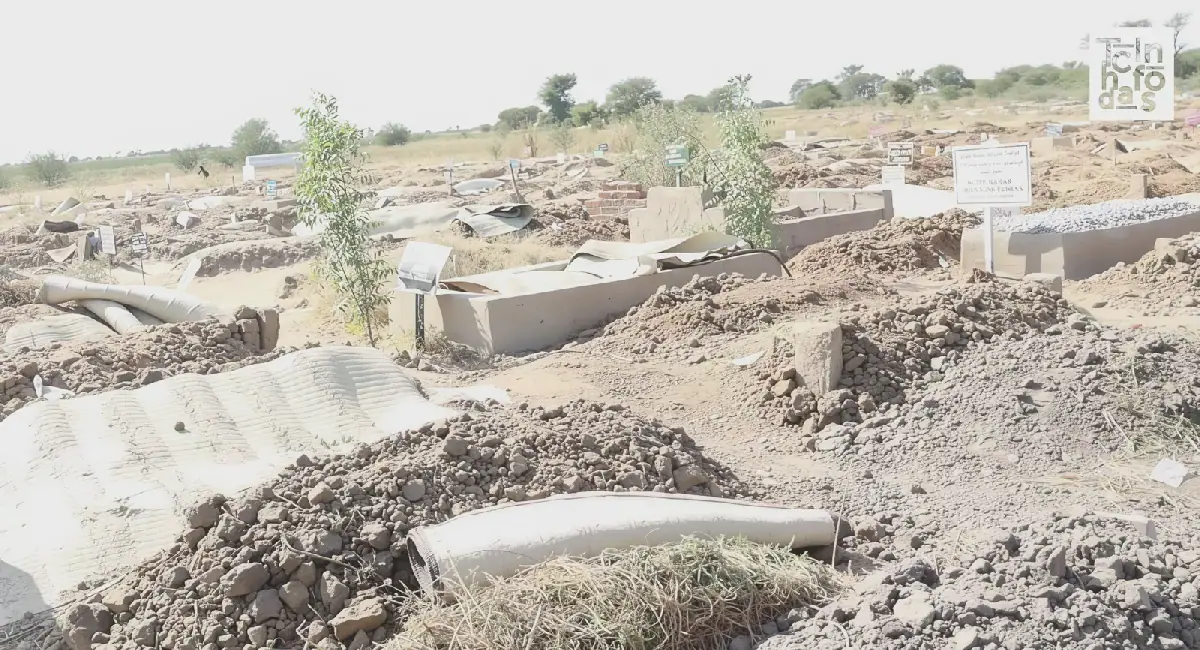
According to a document from municipal services accessed by Tchadinfos, 2,072 deaths were recorded at Lamadji cemetery, one of the main burial sites in N'Djamena, Chad, between October 1 and 31, 2026. This represents an average of nearly 67 deaths per day. The data was released amid a dengue epidemic and a high influx of patients in healthcare facilities in the capital.
The document, which provides a daily breakdown of deaths, reports 93 deaths on October 29, 76 on October 30, and 61 on October 31. However, it does not specify the medical causes of the recorded deaths. This information comes as the weekly publication Abba Garde released the results of an investigation into two cemeteries in the capital, Lamadji and Toukra, on November 1.
Abba Garde's investigation, conducted among cemetery guards, reported 861 burials in the two cemeteries over six days, from October 26 to 31, including 593 at Lamadji and 268 at Toukra. For the same period, the municipal document accessed by Tchadinfos reports 437 deaths recorded at Lamadji, compared to 593 burials reported by Abba Garde, a difference of 156.
The methods used to count deaths and burials by the two sources need clarification, particularly the distinction between recorded deaths and actual burials. Although the municipal figures are lower than those reported by the weekly publication for this period, they still indicate an average of nearly 67 deaths per day throughout October at Lamadji cemetery.
These numbers are made public against the backdrop of a dengue epidemic, with several hospitals in N'Djamena facing a significant influx of patients. Health authorities have initiated response and awareness actions, while emphasizing that not all deaths observed in the capital can be attributed to dengue.
Neither the municipal document nor Abba Garde's investigation allows for the determination of how many of these deaths are linked to dengue, malaria, or other pathologies. The publication of this data raises questions about the evolution of mortality in the capital and the need for consolidated statistics covering all cemeteries and the medical causes of deaths.
The situation highlights the need for accurate and comprehensive data to assess the extent of the health situation in N'Djamena. The Chadian Ministry of Health has previously stated that not all deaths recorded in N'Djamena are related to dengue, emphasizing the importance of understanding the actual causes of mortality.
Key points
- Over 2,000 deaths recorded at Lamadji cemetery in N'Djamena, Chad, in October 2026
- Deaths recorded amid a dengue epidemic and high influx of patients in healthcare facilities
- Need for consolidated statistics on mortality and causes of death in N'Djamena