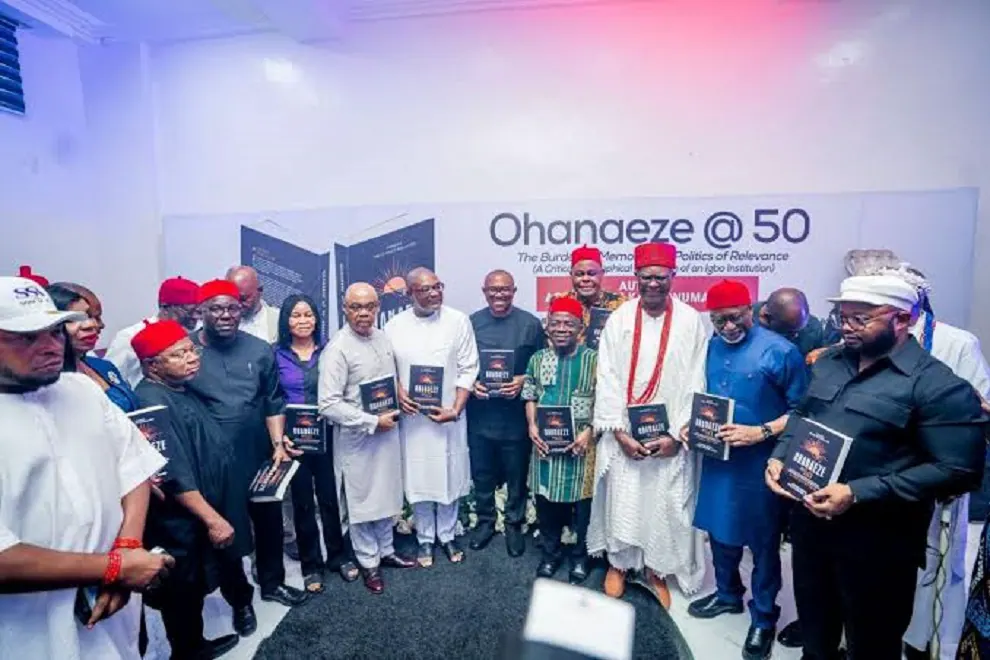
Abia State Governor Alex Otti has called on Ndigbo to shift their focus from historical nostalgia to building institutions that can secure the destiny of future generations. He made this appeal during the public presentation of a book titled "Ohanaeze at 50: The burden of memory, the politics of relevance – a critical biographical reflection of an Igbo institution," authored by Agbaeze Onuma. The book, which has 602 pages, is not just a chronicle of Ohanaeze Ndigbo but a profound reflection on memory, identity, leadership, responsibility, and the future of the Igbo.
Governor Otti described the book as a mirror that holds up the reflection of Ohanaeze Ndigbo at 50. He emphasized that a 50th anniversary should not be celebrated alone but should also be a time for sober reflection on an institution's journey, relevance, and future. According to him, an institution cannot live indefinitely on the strength of its history; instead, heritage gives an organization legitimacy, but relevance must be earned continuously. Otti stressed that Ndigbo must confront critical questions about Ohanaeze's current state, what it should be, and what it must do to remain relevant.
The governor noted that the future of Ndigbo cannot be secured by history alone but by institutions that understand the aspirations of young people, embrace technology and innovation, engage the global Igbo diaspora, and translate cultural identity into economic, intellectual, and political power. He praised the author's metaphor of the Iroko tree, which is deeply rooted, enduring, and imposing, but also grows new branches to remain alive. Otti emphasized that the question is not whether Ohanaeze has a glorious history but whether that history can become the foundation for an even more consequential future.
Otti called for the building of institutions that outlive personalities and political seasons, describing the book as both a reflection on the past and a call to action for institutional renewal. He commended the author for his courage and recommended the book to all interested in the history, identity, unity, and future of Ndigbo. The chairman of the occasion, Elder U. K. Eke, urged that the ideas in the book be translated into practical action, saying the book makes a compelling case for a review of governance frameworks needed for regional transformation.
The book reviewer, Prof. Okey Anueyiagu, linked the themes of the book to Otti's political journey, describing it as a story of resilience and service. He recalled a conversation with Otti seven years ago, where Otti expressed his desire to lead his people, despite lacking money. Anueyiagu said Otti's performance in Abia State has shown that transition from the private sector to public service can produce positive change. He expressed optimism that Abia would surpass other states.
Author of the book, Onuma, praised Governor Otti, saying his performance in Abia State has demonstrated that transition from the private sector to public service can produce positive change. Onuma expressed confidence in Otti's leadership and the future of Abia State. The event had in attendance several notable figures, including former Group Managing Director of FBN Holdings Plc, Elder U. K. Eke.
The presentation of the book and Otti's address have sparked a renewed call to action for Ndigbo to focus on building futuristic institutions. Key stakeholders have begun to explore ways to translate the ideas in the book into practical action, with many expressing optimism about the future of Ndigbo under Governor Otti's leadership. The book has been hailed as a critical reflection on the past, present, and future of Ohanaeze Ndigbo and a call to action for institutional renewal.
Key points
- Abia State Governor Alex Otti has challenged Ndigbo to move beyond nostalgia and build institutions capable of securing the destiny of generations yet unborn.
- Otti made the call during the public presentation of a book, “Ohanaeze at 50: The burden of memory, the politics of relevance – a critical biographical reflection of an Igbo institution,” authored by Agbaeze Onuma.
- The governor emphasized that an institution cannot live indefinitely on the strength of its history; instead, heritage gives an organization legitimacy, but relevance must be earned continuously.