The Osun River, a central figure in Yoruba cosmology, originates in Igede Ekiti, Ekiti State, and flows southward through Osogbo. Its waters became integral to the city's religious, political, and cultural fabric. Yoruba tradition imbued natural features like rivers and forests with deep spiritual meaning. The river's waters are linked with Osun, the Yoruba deity of fertility, healing, protection, and prosperity. This ancient belief solidified around a specific stretch of the river and its surrounding forest in Osogbo.
The emergence of Osogbo as a spiritual hub for Osun worship began with the people of Ipole Omu, led by King Olarooye, facing hardship in their original settlement. Prolonged dry seasons threatened their survival, prompting King Olarooye to dispatch his chief hunter, Olutimehin, to find a more hospitable settlement. Olutimehin discovered the fertile area around the Osun River, offering the desperate migrants a new chance at life. This moment marked a pivotal shift for a community seeking survival and new beginnings.
A sacred pact was formed between King Olarooye and Osun during the initial clearing of the new settlement's forest. According to traditional accounts, settlers felled a tree that struck Osun's dye pots, creating a spiritual confrontation. A voice from the river, believed to be Osun, lamented the damage, while other voices emerged from the forest in sympathy with Osun. This incident led to a covenant between King Olarooye and Osun, with the deity promising protection and prosperity, and the people vowing to respect her sacred domain and establish a shrine.
The covenant gave birth to the royal title of Osogbo's king, the Ataoja. Tradition holds that during a sacrifice to seal the agreement, a golden fish, Iko, emerged from the river to receive the offering from King Olarooye's hands. This event gave rise to the praise name "Oba Atewo Gbeja," which evolved into Ataoja, meaning "the king who received the golden fish with outstretched palms." The Ataoja became more than just a political leader; the office embodied the city's foundational spiritual relationship with Osun.
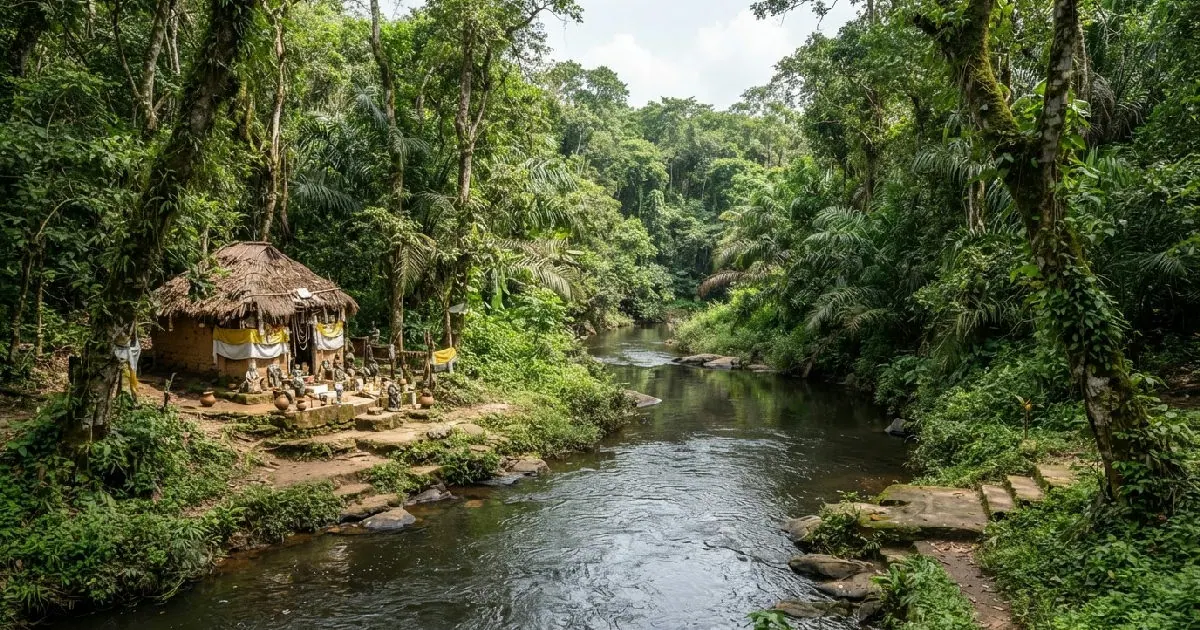
The Osun Osogbo Sacred Grove stands as a vibrant testament to this covenant. This surviving sacred forest, nestled along the riverbanks, remains a living expression of Yoruba spiritual and cultural heritage. It is filled with shrines and sculptures, continually renewed by generations of worshippers. The grove's recognition by UNESCO highlights its universal cultural value and the importance of its preservation.
Annual festivals draw devotees and tourists alike, showcasing the enduring power of these traditions. For generations, the custodians of the grove and the Ataoja ensured the continuity of these sacred practices. This sustained commitment reinforced the belief that the community's prosperity remained linked to their reverence for Osun. The relationship transcended generations, becoming a cornerstone of Osogbo identity.
Understanding the dichotomy between the physical Osun River and Osun, the Yoruba divinity, is crucial. The river's source is in Igede-Ekiti, marking the beginning of its geographical journey. However, Osogbo developed as the principal centre of Osun worship due to a unique historical encounter and covenant. This distinction highlights how communities can transform natural elements, imbuing them with spiritual significance that transcends their physical origins.
Key points
- The Osun River's source lies in Igede Ekiti, but Osogbo became the spiritual heart of Osun worship due to a unique historical encounter and covenant.
- The Osun Osogbo Sacred Grove is a living expression of Yoruba spiritual and cultural heritage, recognized by UNESCO for its universal cultural value.
- The Ataoja's authority is deeply tied to the sacred history of the river and the city's identity, embodying the city's foundational spiritual relationship with Osun.