Commuters in Osogbo, the capital of Osun state, faced significant disruptions to their daily travels on September 23, 2026, as commercial drivers, known locally as Korope, staged a protest. The protest, led by the Association of Korope Drivers, brought transport services to a halt along major routes in the state capital from early morning until around 2 pm. The drivers cited soaring fuel prices, increased costs of vehicle spare parts, and rising food prices as key reasons for their action.
The protesters converged on Ayetoro junction, a major transport hub, where they parked their vehicles and blocked non-compliant drivers from picking up passengers. This strategic move effectively shut down transport services across the city, leaving many commuters stranded. The drivers' frustration was palpable as they voiced their concerns over the economic hardships they are facing. They accused union leaders of neglecting their welfare and focusing solely on collecting daily ticket revenues.
Abdulwasiu Osuolale, speaking on behalf of the protesting drivers, expressed deep frustration with the union leadership. He claimed that the leaders are indifferent to the drivers' plight, prioritizing the collection of daily ticket money over supporting their members during difficult economic times. Osuolale highlighted the unsustainable costs of fuel and vehicle maintenance, which have made their transport operations unprofitable. He also announced that the drivers had officially increased transport fares across Osogbo in response to their rising costs.
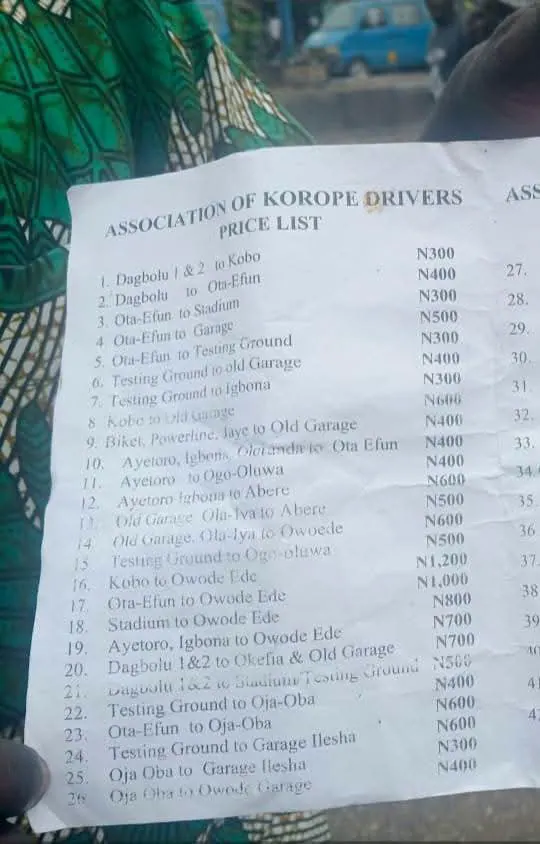
The new fare structure, as announced by the Association of Korope Drivers, includes a flat rate of N300 for the shortest routes within Osogbo. For longer routes, such as Ayetoro/Igbona to Owode-Ede, and Dagbolu 1 & 2 to Okefia/Old Garage, the fare is now set at N700. The highest fare, for the longest route from Kobo to Owode-Ede, is N1,200. These changes reflect the drivers' efforts to cope with the economic challenges they are facing.
Emmanuel Olowu, Executive Director of the Osun-based civil society group Socio-Economic and Civic Rights Advocacy, responded to the demonstration by commending the drivers for conducting a peaceful protest. He noted that the drivers' actions represent a legitimate form of expressing grievances in a democracy. Olowu also acknowledged the broader issues with the current transport ticketing system, emphasizing that the system, which allows non-government entities to collect revenue without adequate oversight, is no longer tenable.
The protest by the Korope drivers highlights the significant impact of economic challenges on everyday Nigerians. The rising costs of fuel, spare parts, and food have created a difficult environment for transport operators, who are now seeking relief through fare increases and better management of ticket revenues. The situation underscores the need for dialogue between transport operators, union leaders, and government authorities to find sustainable solutions to these challenges.
The outcome of the protest and the implementation of the new fare structure remain to be seen. The drivers' demands for better support from union leaders and more transparent management of ticket revenues are clear. As the situation develops, it will be important to monitor how these changes affect commuters and the broader transport sector in Osun state.
Key points
- The protest was led by the Association of Korope Drivers in Osogbo, Osun state capital, on September 23, 2026.
- The drivers protested rising fuel costs, increased vehicle spare parts prices, and alleged mismanagement of daily ticket revenues by union leadership.
- The protest resulted in a new fare structure for intra-city transport in Osogbo, with fares ranging from N300 to N1,200 depending on the route.