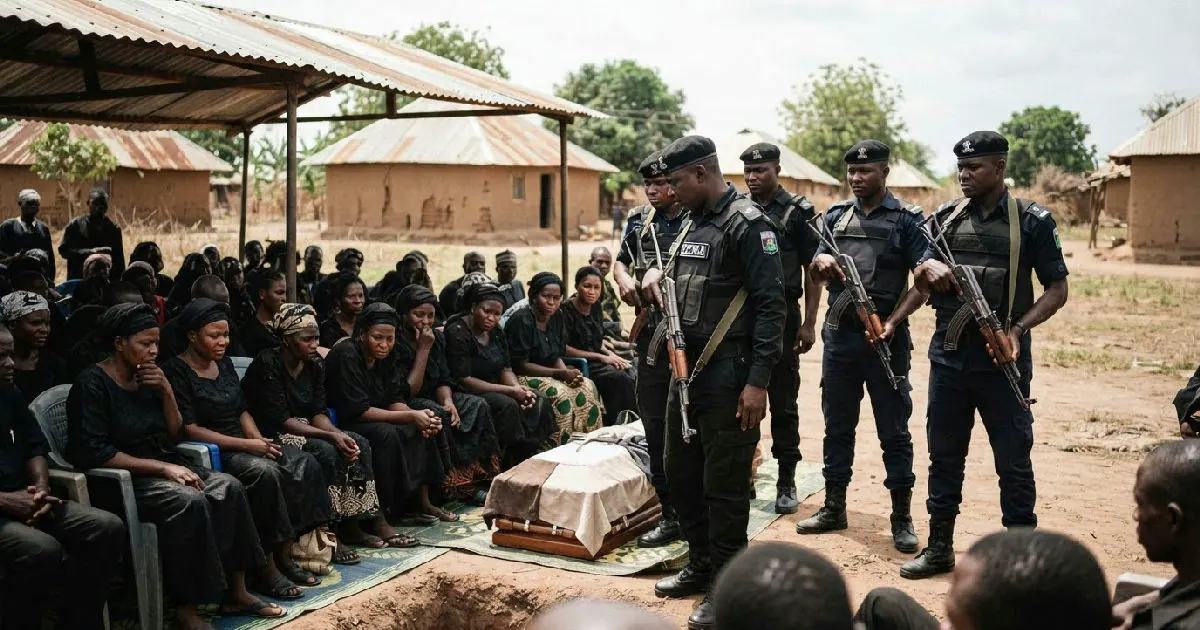
A tragic incident on July 27, 2024, in Tse Angaador, a quiet farming village in Benue State, has brought attention to the alleged abuses committed by Operation Zenda Benue. During a funeral vigil for Kumawuese Bam, the police suddenly opened fire, resulting in the deaths of seven people, including Kumawuese's younger brother, Aondoakura. Polycarp Yaapera, who attended the vigil, recounted the chaos and hid behind a mud wall for five minutes as the shooting unfolded.
The victims of the Tse Angaador massacre, including Ordughga Tyoapine, Kater Tarpav, and Yaapera Aondoakura, were buried on August 10, 2024. Community representatives met with local officials, including then-chairman of Logo Local Government Area, Benjamin Uzenda, who reportedly admitted the killings were a police "error" but warned against further action. Solomon Wombo, the community's House of Representatives member, provided ₦500,000 for the victims' burials but did not respond to inquiries about accountability or follow-up actions.
This incident was not an isolated aberration, as Operation Zenda Benue has been accused of multiple human rights abuses. Six months prior to the Tse Angaador massacre, on January 12, 2024, the unit conducted a similar raid in Tse Jikina, another community within Logo Local Government Area. The objective was reportedly to arrest Iorhom Orkile, an herbal practitioner accused of supplying charms to bandits. Residents recounted officers searching compounds without warrants and assaulting locals.
The Tse Jikina raid resulted in significant damage, with 25 burnt and abandoned houses documented by PREMIUM TIMES in January 2026. One of these belonged to Zuamo Tornyor, a university student whose family home was destroyed in the raid. Tornyor Orkile, Iorhom's brother, filed a suit against the police, Operation Zenda, and Akegh Ernest, but the case was later struck out due to a judge's transfer and alleged pressure to drop the complaint.
Operation Zenda Benue has also faced allegations of deaths and disappearances in its custody. In May 2022, Emmanuel and Terna Chado were watching a football match in Tor Mkar Mbazerem when Terna was arrested by the police. His family never saw him alive again, and police claimed Terna died on May 17, 2022, from a stray bullet during a gun exchange. The family disputed this account, and a court later awarded ₦50 million in compensation for his extrajudicial execution.
The fate of Paul Achov, arrested on August 2, 2025, at a Makurdi relaxation spot, remains officially unresolved. Human rights activist Ukan Kurugh obtained a police report labelling Achov a criminal gang member, but no evidence or formal charge was presented. Kurugh's petition to national authorities led to information from a police source suggesting Achov had been killed. His sister, Ruth, pleaded for accountability, demanding that the police either charge him to court or clear his name.
The repeated instances of alleged human rights abuses by Operation Zenda Benue present a disturbing picture of an unchecked police unit operating with little regard for human rights or due process. The unit's actions seem to disregard the very principles of law enforcement, highlighting broader challenges faced by Nigeria's institutions. The families of the victims continue to demand accountability and justice for the alleged crimes committed by Operation Zenda Benue.
Key points
- Operation Zenda Benue, an elite police unit in Nigeria, has been accused of numerous human rights abuses, including extrajudicial killings and forced disappearances in Benue State.
- The unit's alleged abuses have resulted in significant damage to communities and have raised serious questions about police accountability in Nigeria.
- The families of the victims continue to demand accountability and justice for the alleged crimes committed by Operation Zenda Benue.