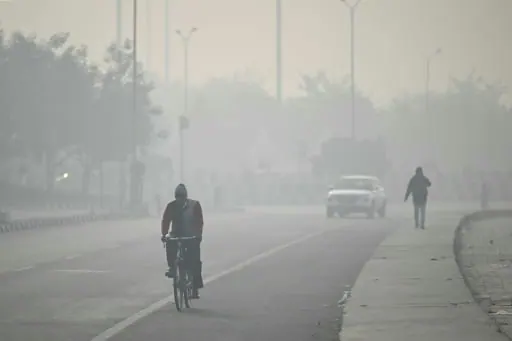
A recent report by the European Union's Copernicus Climate Atmosphere Monitoring Service (CAMS) has highlighted the alarming impact of climate change on air pollution. The report, which covered the first eight months of 2026, found that one third of the global population was exposed to extremely high levels of ozone pollution. This was largely driven by record-breaking heatwaves and wildfires that occurred in various parts of the world, including Europe and North America.
The report noted that ozone pollution is formed when heat and sunlight react with airborne emissions from wildfires, vehicles, and industry. This can damage lung tissue, cause breathing problems, trigger asthma attacks, and lead to other health issues. Despite progress in reducing the most harmful air pollutants in recent decades, ozone has proven more difficult to tackle due to climate change. The World Health Organization's guideline sets 100 micrograms of ozone per cubic metre as the maximum recommended level of exposure, averaged over eight hours.
According to the report, 34 percent of the global population was exposed to "extremely poor" air quality between January 1 and September 15. Another 17 percent of the world breathed "very poor" air, while five percent was exposed to "good" levels of ozone. Asia has the highest rate of exposure to ozone pollution, with 53 percent of its population breathing "extremely poor" air. Cities such as New Delhi, Dhaka, Chongqing, and Lahore were among those with "extremely poor" ozone levels.
The report also highlighted the impact of air pollution on different continents. Two thirds of the population in North America and 45 percent in Europe were exposed to "poor" or "very poor" air quality. In Africa, 8 percent of the population endured "extremely poor" air quality, while 19 percent experienced "very poor" or "poor" air quality. In contrast, 66 percent of the population in Oceania, including Australia and New Zealand, enjoyed "good" ozone levels.
The report's findings have significant implications for public health. Ozone pollution is linked to 60,000 premature deaths per year in Europe, according to Ian Marnane, an official at the European Environment Agency. The report also noted that EU regulation has been effective in reducing emissions from air pollutants, except for ozone. In North America, ozone levels remained "relatively unchanged" despite ambitious emissions reduction policies.
The CAMS report used satellite data and computer models to track air pollution and wildfires. The service's director, Laurence Rouil, emphasized that air pollution does not stop at borders and can travel thousands of kilometres, affecting air quality far from its source. The report's findings highlight the need for continued efforts to address air pollution and climate change.
The report's release comes as Indonesia experiences major wildfires, and the warming El Nino weather pattern is expected to drive more fires in southeast Asia. The situation highlights the need for international cooperation to address the root causes of air pollution and climate change.
Key points
- One third of the global population was exposed to extremely high levels of ozone pollution this year.
- Asia has the highest rate of exposure to ozone pollution, with 53 percent of its population breathing "extremely poor" air.
- Ozone pollution is linked to 60,000 premature deaths per year in Europe.