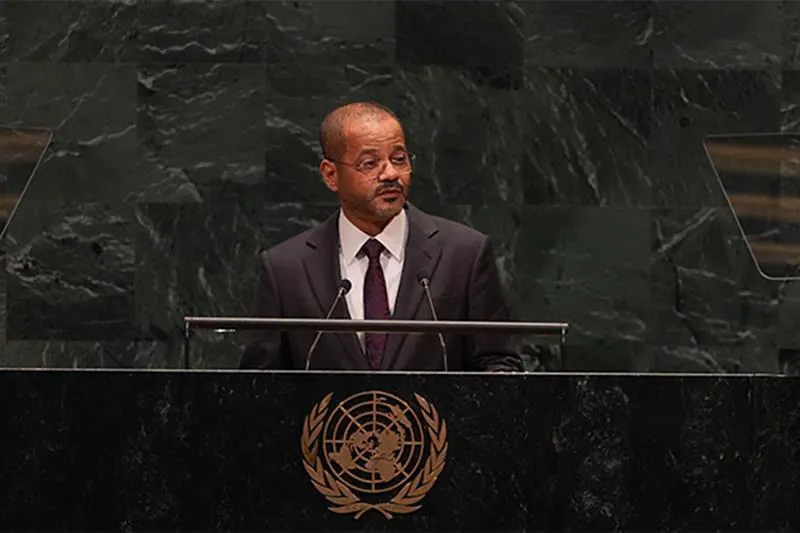
Oman's Foreign Minister, Badr al-Busaidi, has called on countries involved in the Middle East conflict to exercise restraint and engage in dialogue to find a peaceful solution. Speaking at the United Nations General Assembly in New York, al-Busaidi emphasized the need for a consensual and durable agreement that benefits all parties. He also reaffirmed Oman's commitment to securing navigation in the Strait of Hormuz.
The conflict in the Middle East has been escalating since late February, when the United States and Israel launched strikes on Iran. The Islamic Republic has since claimed control of the Strait of Hormuz, a vital waterway through which a fifth of the world's hydrocarbons pass. In response, the US has imposed a blockade on Iranian ports. Oman's call for restraint and dialogue comes as tensions in the region continue to rise.
Al-Busaidi's statement was made in response to the ongoing conflict and the need for a peaceful resolution. He emphasized that Oman is willing to assist in any mediation efforts to resolve the crisis. The country's strategic location on the opposite side of the Strait of Hormuz makes it an important player in regional efforts to secure navigation and trade.
The Strait of Hormuz has become a focal point in the conflict, with Iran recently announcing the seizure of a US underwater drone. The incident has further heightened tensions in the region. Oman's efforts to secure navigation in the strait have been ongoing, with the country providing an alternative route for ships seeking to avoid Iranian restrictions.
The US has rejected an Iranian proposal for a truce that would have led to the reopening of the Strait of Hormuz within seven days. The rejection has further complicated efforts to find a peaceful solution to the conflict. Oman's call for restraint and dialogue is seen as an effort to find a middle ground and encourage negotiations.
The conflict in the Middle East has far-reaching implications for global trade and security. The Strait of Hormuz is a critical waterway for the transportation of hydrocarbons, and any disruption to navigation could have significant economic consequences. Oman's efforts to promote dialogue and restraint are seen as an important contribution to regional and global stability.
The international community has been closely watching developments in the Middle East, with many countries calling for a peaceful resolution to the conflict. Oman's Foreign Minister has reiterated his country's commitment to working with all parties to find a solution that benefits everyone. The situation remains volatile, and efforts to promote dialogue and restraint are ongoing.
Key points
- Oman calls for restraint and dialogue to resolve Middle East conflict
- Strait of Hormuz is a critical waterway for global hydrocarbon transportation
- Conflict has significant implications for regional and global stability