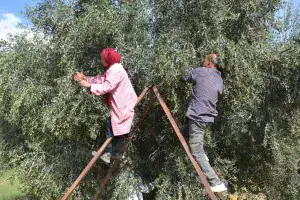
The 2026-2027 olive harvesting season officially began in Tunisia's Kairouan region on Monday, with the launch event taking place at a farm in the Bouhajla delegation. The event was attended by the regional governor, the regional agricultural development delegate, and several other officials. This year's season is expected to yield around 275,000 tons of olives, a 10,000-ton increase from the previous season, and approximately 57,000 tons of olive oil.
According to Murad Ben Omar, the regional agricultural development delegate for Kairouan, the olive sector provides around 2 million working days per year, particularly during the harvesting and pressing phases. This highlights the sector's significant economic and social role in the region, contributing to the local economy's dynamism. The total area dedicated to olive cultivation in the region is currently around 190,000 hectares, with 13.2 million olive trees.
The Bouhajla delegation is expected to be the top producer, with an anticipated output of 92,000 tons, followed by Hafouz with 40,000 tons, and Cherarda with 27,000 tons. Other delegations, including Nasrallah, Sbeika, and Chebika, are expected to have similar production levels. The region's olive production has been increasing in recent years, rising from 148,000 tons in the 2021-2022 season to 265,000 tons in the previous season.
The number of olive oil presses in the region has also increased, from 150 in 2022 to 207 this season, representing a 38% increase. The annual processing capacity has grown from 420,000 tons to over 700,000 tons. The Bouhajla delegation has the largest number of presses, with 79, followed by Sbeika, Cherarda, and Kairouan South.
In preparation for the season, regional authorities have been working to manage and valorize olive pomace, a byproduct of olive oil production. This includes inspecting and cleaning collective and individual disposal sites, as well as encouraging olive oil producers and farmers to participate in agricultural valorization programs.
The region has a total available capacity of 210,000 cubic meters for olive pomace disposal, with the potential to add 50,000 cubic meters. The capacity is distributed across various delegations, including Cherarda, Bouhajla, Sbeika, and Chebika. These efforts aim to mitigate environmental impacts and promote sustainable agricultural practices.
Local olive producers and press owners have highlighted several challenges facing the sector, including the impact of heatwaves on olive quality and the need for a reference price for olive sales. They have also called for faster financing for producers and press owners to ensure a smooth harvest season. Meanwhile, a awareness campaign has been launched to educate farmers on how to prevent the spread of olive leaf disease.
Key points
- The Kairouan region expects to produce 275,000 tons of olives and 57,000 tons of olive oil this season.
- The olive sector provides around 2 million working days per year in the region.
- The number of olive oil presses in the region has increased by 38% this season.