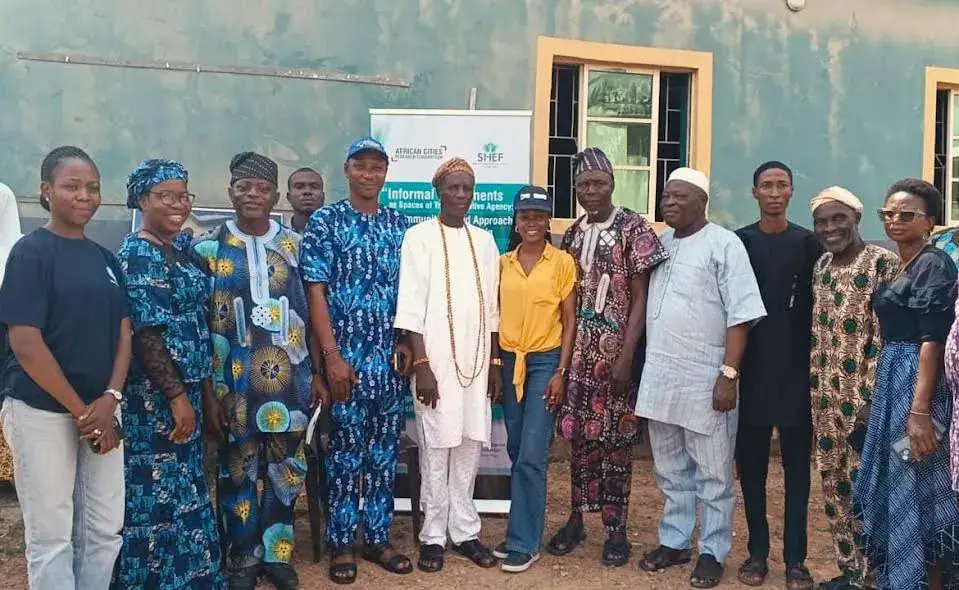
Efforts to address water, sanitation and hygiene challenges in Okerube, Lagos, have gained fresh momentum as community leaders, government representatives and project partners agree to deepen collaboration. The stakeholder meeting, held on November 14, 2026, brought together representatives of Community Development Associations, women and youth groups, religious leaders, the councillor and the Baale of Okerube. They reviewed progress on the WASH intervention being implemented by SHEF with funding support from ACRC.
The meeting highlighted growing government involvement in the project, including the inspection of a proposed site for public toilets and progress towards providing additional water infrastructure and electricity. Community mobiliser Funmilayo Daniel reported significant progress since the previous stakeholder engagement, particularly in securing land for the project and strengthening collaboration between residents and government authorities. The Lagos State Government had inspected a proposed site for public toilets following its commitment to support the provision of the facilities.
Daniel disclosed that the community's request for road grading was yet to receive government approval, while requests for an additional borehole and transformer had been approved. Government contractors had inspected the proposed transformer site and advised the community to construct a basement, which had already been completed. This progress indicates a strong commitment from both the community and government to support the WASH project.
Seun Muraina, a lecturer at the University of Lagos and Co-Lead of the project, explained that the intervention was designed to establish a community-driven system capable of sustaining the facilities after installation. ACRC supports action research and community-driven interventions across several African cities, including Lagos, with emphasis on enabling residents to identify challenges and participate in developing solutions.
Muraina identified citizen mobilisation, reform coalitions, elite commitment and state-capacity strengthening as the four principles guiding ACRC's interventions. She stressed that sustainable development could not be achieved through projects imposed on communities without the participation of the people expected to benefit from them. The Okerube intervention adopts a co-production model under which residents participate in decisions on the facilities required and how they should be managed.
The project framework includes community ownership structures, designated representatives responsible for managing the facilities and modest financial contributions towards maintenance and repairs. Residents would also receive training in financial management to ensure the sustainability of the facilities. This approach ensures that the facilities provided would remain functional beyond their initial installation.
The Okerube WASH project is a significant step towards addressing the water, sanitation and hygiene challenges in the community. With the support of both the community and government, the project is expected to make a lasting impact on the lives of residents. Key aspects of the project include community-driven solutions, government support and a focus on sustainability.
Key points
- The Okerube WASH project adopts a co-production model that encourages community participation in decision-making and facility management.
- The project framework includes community ownership structures and modest financial contributions towards maintenance and repairs.
- The intervention is designed to establish a community-driven system capable of sustaining the facilities after installation.