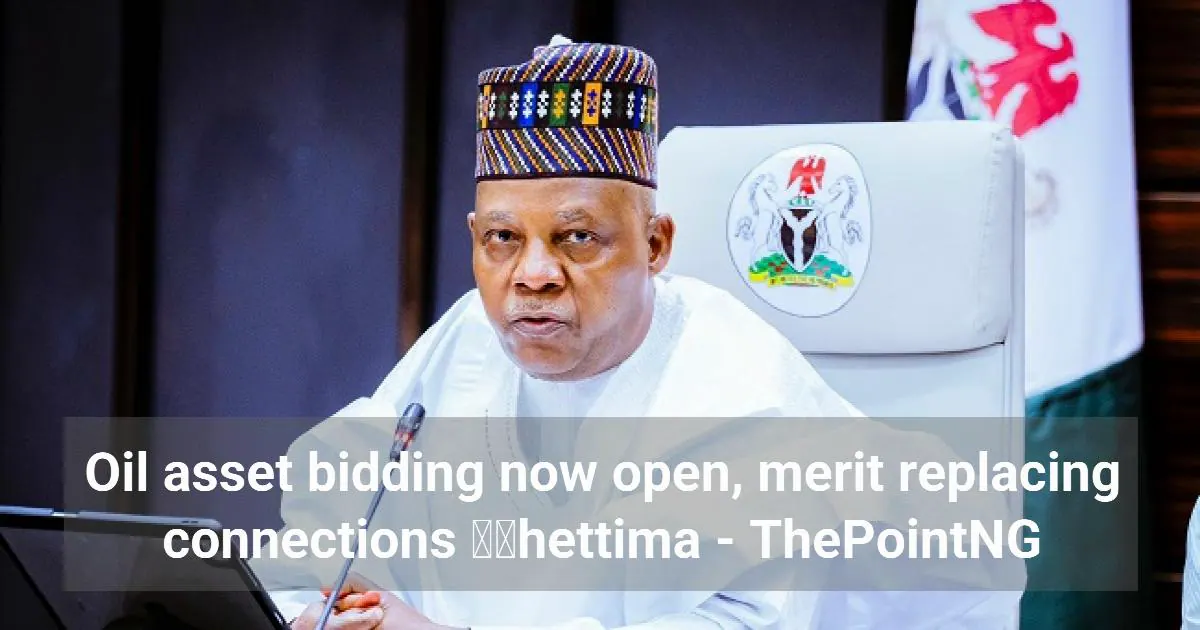
Vice President Kashim Shettima has stated that reforms in Nigeria's upstream petroleum sector have significantly improved transparency in the allocation of oil assets. He made this statement on Tuesday in Abuja while representing President Bola Tinubu at the fifth anniversary celebration of the Nigerian Upstream Petroleum Regulatory Commission. According to Shettima, the Federal Government has introduced open and competitive processes for awarding oil acreages.
The new process allows investors to compete for acreages without relying on political connections. Shettima cited the experience of a friend who successfully secured an upstream asset despite having no political connections. This, he said, demonstrates that participation in Nigeria's oil licensing process is increasingly being determined by merit and transparent competition rather than access to political influence.
The Vice President noted that the Federal Government is working to position Nigeria as a preferred destination for investors seeking long-term opportunities in the oil and gas industry. He stated that the Petroleum Industry Act has strengthened the sector by establishing clearer rules and creating a more predictable regulatory environment for investors. This, he believes, will encourage more investors to participate in the industry.
Shettima also highlighted the increased role of host communities in petroleum-producing areas, which provides them with a greater stake in the activities taking place within their communities. He commended the Nigerian Upstream Petroleum Regulatory Commission for its role in implementing the reforms and rebuilding investor confidence in Nigeria's upstream petroleum industry.
The country has witnessed improvements in crude oil production as security agencies, operators, host communities, and the regulator intensified efforts to address oil theft, pipeline vandalism, and other challenges affecting production. Shettima stated that investors who once looked elsewhere are returning, and for two years now, Nigeria has been ranked Africa's leading destination for investment in the sector.
The Vice President further highlighted measures introduced by the Federal Government to lower the cost of investment and strengthen the fiscal and regulatory framework governing upstream operations. Among these measures is the Deep Offshore Oil and Gas Project Incentive Tax Remission Order 2026, which aims to unlock as much as $50bn in fresh investment in the sector.
Shettima urged the Nigerian Upstream Petroleum Regulatory Commission to sustain its commitment to transparency and ensure that investors receive predictable timelines throughout regulatory processes. He also warned that companies receiving government incentives must reciprocate by meeting their obligations under approved work programmes, including requirements relating to local content, environmental protection, and the development of host communities.
Key points
- The Nigerian government has introduced open and competitive processes for awarding oil acreages.
- The Petroleum Industry Act has strengthened the sector by establishing clearer rules and creating a more predictable regulatory environment for investors.
- The country has witnessed improvements in crude oil production due to efforts to address oil theft and pipeline vandalism.