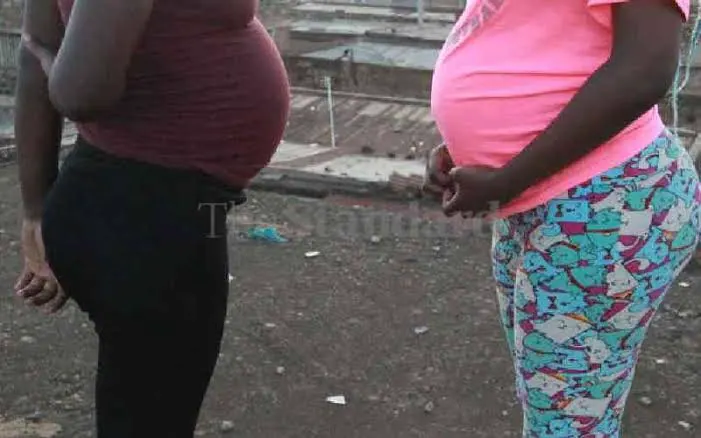
Education Cabinet Secretary Julius Ogamba has informed the Senate that his ministry lacks a comprehensive framework and information management system to aggregate data on reported learner pregnancies and the perpetrators involved. Appearing before the Senate plenary to respond to member queries, CS Ogamba explained that under the 2020 Re-entry Guidelines, school heads and teachers serve as the primary points of contact for identifying and reporting cases of pregnant learners and child mothers.
However, he pointed out significant gaps in monitoring and reporting, noting that some school heads hesitate to share information out of fear that exposing institutional vulnerabilities might harm their schools' reputations. Ogamba told lawmakers that available data is mainly drawn from national surveys undertaken through the health sector. In the first five months of 2023, for example, the Kenya Health Information System recorded 110,821 cases among adolescents aged 10 to 19.
The CS was responding to questions posed by Nominated Senator Catherine Mumma, who sought details on how the ministry monitors teenage pregnancies among learners, the tools used to consolidate such data, and county-by-county statistics for 2023 and 2024. Senator Mumma also demanded to know how many cases involved teachers as perpetrators and how many resulted in successful prosecutions.
CS Ogamba clarified that tracking perpetrators requires a multi-agency framework involving the Ministry of Education, the Teachers Service Commission (TSC), and law enforcement bodies including the National Police Service, the Director of Public Prosecutions (ODPP), and the Judiciary. He explained that designation as a perpetrator implies that a disciplinary and/or criminal justice process has been concluded with a finding against the suspect.
Citing national health surveys, the Cabinet Secretary revealed that teenage pregnancy rates vary widely by region. In 2022, counties with the highest rates among young women aged 15–19 included Samburu (50.1%), West Pokot (36.3%), Marsabit (29.4%), Narok (28.1%), Meru (23.6%), Homa Bay (23.2%), Migori (22.4%), Kajiado (21.8%), and Siaya (20.9%).
Responding to queries on re-enrollment efforts, Ogamba stated that the framework supporting child mothers is anchored in the Constitution—which guarantees free and compulsory basic education—and the Basic Education Act of 2013. This is operationalized through the National Guidelines for School Re-entry in Early Learning and Basic Education (2020), which provide clear procedures for schools to follow in the treatment of girls during pregnancy and post-pregnancy.
Ogamba highlighted barriers preventing teen mothers from returning to class, including financial distress, childcare costs, peer stigma, and family rejection. He noted that young mothers face stigma from peers and even their own families, which can lead to school transfer and dropout. The ministry currently lacks disaggregated data on exact re-enrollment numbers or those remaining out of school, but the upgraded Kenya Education Management Information System (KEMIS) is being configured to capture these metrics.
Key points
- The Ministry of Education lacks a comprehensive framework to track learner pregnancies and perpetrators.
- Teenage pregnancy rates vary widely by region, with Samburu, West Pokot, and Marsabit recording the highest rates in 2022.
- The ministry is working on a system to bring together all agencies for sharing data on learner pregnancies and perpetrators.