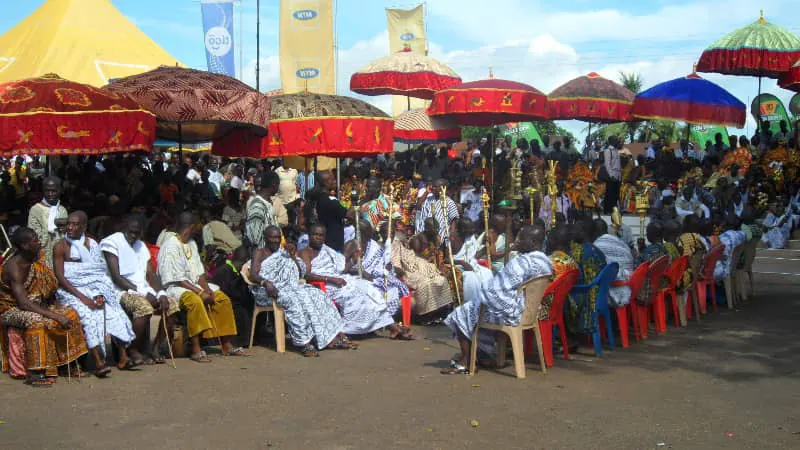
The Odwira festival, a significant cultural event in Ghana, is celebrating its 200th anniversary, starting from September 21, 2026. The festival's origins have sparked debate, with some attributing its beginning to the capture of a sacred Asante object at the Battle of Katamanso in 1826. However, historian and genealogist Mr. Kwaku Darko Ankrah argues that the story is more complicated than the popular version suggests. According to him, the Akuapem State had already emerged in the 18th century, following the defeat of Akwamu and the Abotakyi Accord of 1733.
The Battle of Katamanso in 1826 did not create Akuapem as an independent political state, but rather helped protect and consolidate its existing political order. Mr. Ankrah emphasizes that Akuapem's political and spiritual autonomy had already been achieved by 1733. The Odwira festival should not be described as the event that created Akuapem, but rather as a powerful ritual expression of an already existing political community. This distinction is crucial in understanding the festival's origins and evolution.
Research suggests that the Asante had an established Odwira tradition long before the Akuapem festival emerged. The Asante Odwira tradition is believed to have been established in 1717 under Asantehene Osei Tutu I, decades before the emergence of the Akuapem State. This chronology makes it impossible to argue that Akuapem originated the broader institution of Odwira. Instead, an existing Akan ritual tradition acquired a new local, political, and historical meaning after the war in 1826.
The Odwira festival carries meanings beyond harvest, including political authority, allegiance, purification, and the renewal of the social order. In Akuapem, these meanings became intertwined with the memory of the Katamanso confrontation. The festival consequently brought together at least three dimensions: agricultural renewal, spiritual purification, and historical remembrance. This combination helps explain why it survived as a major institution rather than becoming merely a harvest celebration.
There is a distinction between Odosu, regarded as an important spiritual symbol of the Akuapem State, and Odwira Apafram, identified as being of Asante origin. Research suggests that these two objects should not be treated as identical. The Odosu was associated with the spiritual identity of the Akuapem State, while Odwira Apafram was associated with the Asante ritual tradition. The two could both have been important to Akuapem's Odwira rituals without being the same object.
The capture of an Asante sacred object during the Katamanso campaign does not necessarily mean that Akuapem gained sole spiritual authority over Odwira. In typical Akan warfare, the capture of an enemy's sacred object could carry enormous symbolic importance, but that does not necessarily mean the defeated community permanently lost the right to perform the underlying ritual tradition. The historical record of Asante Odwira itself makes this distinction especially important.
Asante may not have permanently lost the right to celebrate Odwira after the Battle of Katamanso. Mr. Ankrah acknowledges that there could be an element of truth in the argument, but emphasizes that this is not the same as historical proof. The celebration of Odwira remains an important part of Ghana's cultural heritage, with Akuapem marking 200 years of the tradition. The festival's evolution and significance will continue to be studied and debated by historians and scholars.
Key points
- The Odwira festival has a complex history that goes beyond the popular narrative of its origins.
- The Akuapem State had already emerged in the 18th century, with its own distinct cultural and spiritual practices.
- The capture of an Asante sacred object during the Katamanso campaign does not necessarily mean that Akuapem gained sole spiritual authority over Odwira.