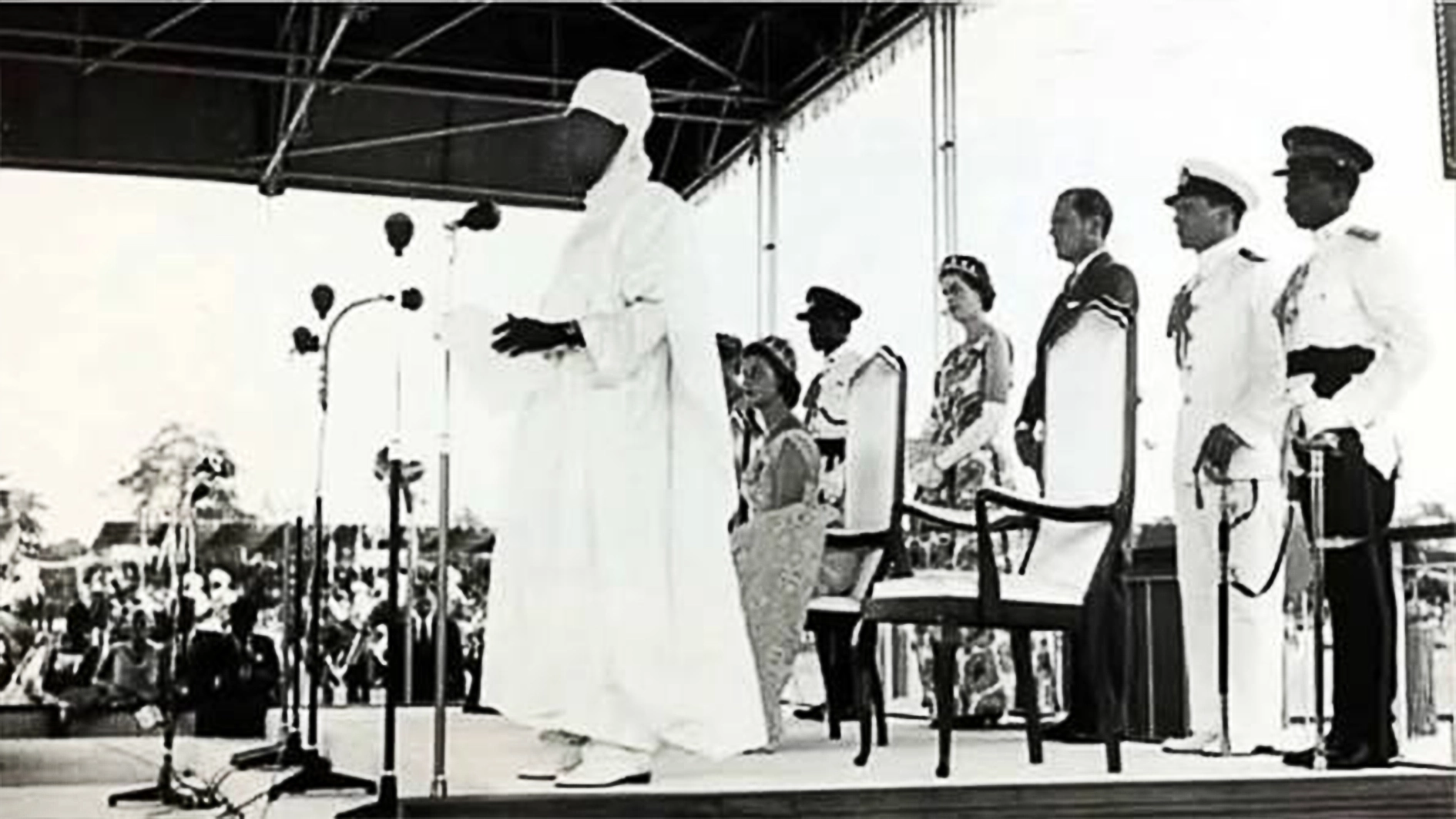
On October 1, 1960, Nigeria gained independence from British colonial rule, with Sir Abubakar Tafawa Balewa as its first and only Prime Minister. As the green-and-white flag rose for the first time, Balewa's speech radiated optimism, envisioning a nation built on firm foundations. His oratory skills earned him the "Golden Voice of Africa." Balewa's address praised a peaceful transition of power, hoping it would serve as a democratic beacon for the continent. This moment marked the beginning of Nigeria's journey as an independent nation. Balewa's leadership played a crucial role in shaping the country's early years. His vision for Nigeria's future resonated with the nation's aspirations.
Balewa faced significant challenges as Prime Minister, navigating a fragile central government amidst fiercely competitive ethno-regional blocs. He had to mediate between dominant regional leaders, including Sir Ahmadu Bello in the North, Dr Nnamdi Azikiwe in the East, and Chief Obafemi Awolowo in the West. Unlike these leaders, Balewa did not have a monolithic regional fortress to command from Lagos. Instead, he relied on compromise to govern the sprawling, multi-ethnic federation. His position required immense diplomatic skill to balance regional anxieties. This delicate act of balancing remains a central theme in Nigerian governance today. Balewa's leadership style continues to influence modern Nigerian politics.
On the international stage, Balewa's diplomacy was highly acclaimed. Under his stewardship, Nigeria secured entry into the United Nations, becoming a respected global player. He led the Commonwealth's opposition against apartheid in South Africa and played a pivotal role in forming the Organisation of African Unity (OAU) in 1963. Balewa represented the sophisticated face of a rising African superpower, earning global recognition. However, this external glory contrasted with domestic turmoil brewing at home. The Western Region emergency of 1962, census controversies, and contentious federal elections showed that local foundations were rapidly cracking. Balewa's administration struggled to suppress rising internal tensions.
Balewa's personal character is a notable aspect of his legacy. He maintained a remarkably simple and ascetic lifestyle, unlike many politicians who accumulated wealth and grand displays of affluence. Balewa was regarded as a reluctant leader, a dedicated teacher from Bauchi who preferred quiet local administration to high-stakes Lagos politics. When his life was cut short during the January 15, 1966, military coup, his modest assets surprised both critics and supporters. His primary estate was a modest house in Bauchi. Balewa's personal integrity and financial modesty offer a powerful moral narrative. His lifestyle serves as a reminder of an era when leadership was viewed as national service rather than personal enrichment.
The trajectory from October 1960 to January 1966 highlights the vulnerability of early post-colonial democracy. High expectations of independence created a volatile environment when the government could not solve deep structural issues overnight. The military intervention that claimed Balewa's life altered the course of Nigerian history, ushering in decades of military rule and a devastating civil war. As citizens reflect on independence, celebrating Sir Abubakar Tafawa Balewa means engaging with his entire story, honouring his patriotism and dignity. His legacy serves as a reminder of Nigeria's foundational promises. Balewa's leadership continues to influence contemporary Nigerian politics and governance.
Balewa's diplomatic triumphs and domestic challenges offer valuable lessons for modern Nigeria. His ability to navigate complex international geopolitics while struggling with internal tensions highlights the classic post-colonial paradox. This paradox continues to affect contemporary Nigerian leaders, who must balance global responsibilities with local pressures. Balewa's legacy serves as a reminder of the importance of leadership integrity, diplomatic skill, and the need to address structural issues. His story provides a mirror to Nigeria's contemporary political soul, highlighting the ongoing struggle to find unity and stability. By examining Balewa's tenure, Nigerians can gain insights into the country's ongoing challenges.
As Nigeria marks another Independence Day, Sir Abubakar Tafawa Balewa remains an enduring symbol of the nation's foundational promises. His golden voice still echoes through history, urging the nation to find unity. Balewa's legacy continues to inspire Nigerians to reflect on their country's journey and the challenges it faces. His story serves as a reminder of the importance of leadership, integrity, and diplomacy. By honouring Balewa's memory, Nigerians can reaffirm their commitment to building a united and prosperous nation.
Key points
- Balewa's personal integrity and financial modesty offer a powerful moral narrative for contemporary Nigerian leaders.
- Balewa's diplomatic triumphs and domestic challenges offer valuable lessons for modern Nigeria.
- The legacy of Abubakar Tafawa Balewa continues to influence contemporary Nigerian politics and governance.