ODM leader Oburu Oginga has emphasized the need for leaders to prioritize youth unemployment in Kenya's development and democratic debate. He warned that the country's educated young people are increasingly finding themselves at a crossroads despite years of schooling and skills acquisition. Oburu argued that the growing disconnect between education and employment is not merely an economic problem but a threat to social stability and democratic future.
Oburu challenged leaders to ensure that development translates into opportunities that enable young people to earn a decent livelihood and participate meaningfully in the economy. He stressed that infrastructure development, while important, cannot be the sole measure of national progress. Instead, he called for greater emphasis on industrial, technological, and agricultural sectors, which have the potential to absorb Kenya's growing youth population and transform education and skills into productive employment.
The ODM leader highlighted the consequences of failing to address youth unemployment, which extend beyond lost incomes. He warned that young people who remain economically excluded can become frustrated and desperate, creating a risk to social cohesion and democratic stability. Oburu emphasized that true democratic stability is anchored on economic dignity and that political freedoms and constitutional rights cannot be fully meaningful to young people who lack economic opportunities.
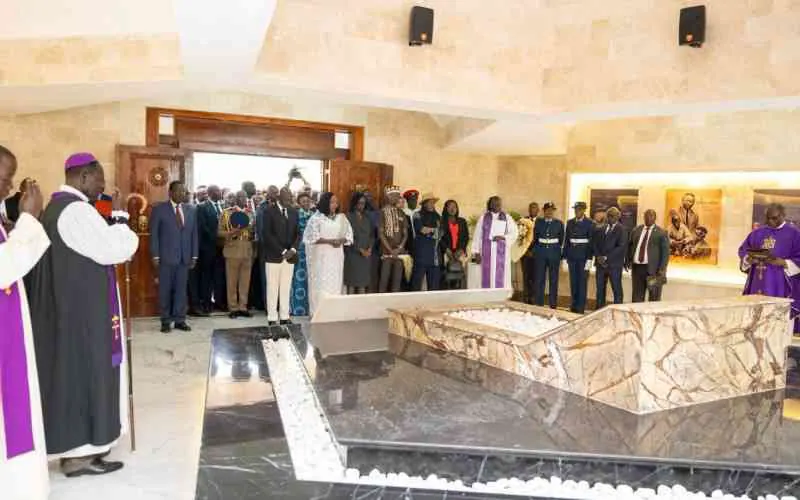
Oburu's remarks were made during the handover ceremony of the Raila Amolo Odinga Mausoleum at Kango ka Jaramogi in Siaya County. The facility is designed to serve as a place of remembrance and a centre for preserving Kenya's political history. The mausoleum will house a state-of-the-art library, historical archives, research materials, and digital repositories documenting the country's political evolution.
The mausoleum is also expected to feature galleries and exhibition spaces showcasing artefacts, speeches, and key moments in Kenya's struggle for constitutional democracy. Oburu described the mausoleum as a living centre of democracy and a symbol of the country's political legacy spanning generations. He recalled his father, Jaramogi Oginga Odinga, as a key figure in Kenya's liberation struggle and pursuit of self-government.
Oburu highlighted the role of the Orange Democratic Movement in Kenya's multiparty political history and acknowledged its participation in the current broad-based government arrangement. He credited the arrangement with contributing to political stability and pointed to infrastructure programmes, universal healthcare, agricultural support, and education reforms as some of the initiatives undertaken. However, he emphasized that such investments must ultimately improve the lives of citizens.
The official opening of the mausoleum is scheduled for 15 October 2026, when it is expected to become a centre for research, political history, and civic education. Oburu, who was observing doctors' instructions to rest and limit physical activity, expressed his commitment to the occasion and his hopes for a more prosperous, united, and peaceful Kenya.
Key points
- Oburu Oginga calls on leaders to prioritize youth unemployment in development agenda.
- Youth unemployment poses a threat to social stability and democratic future.
- Oburu emphasizes the need for economic dignity and meaningful employment opportunities for young people.