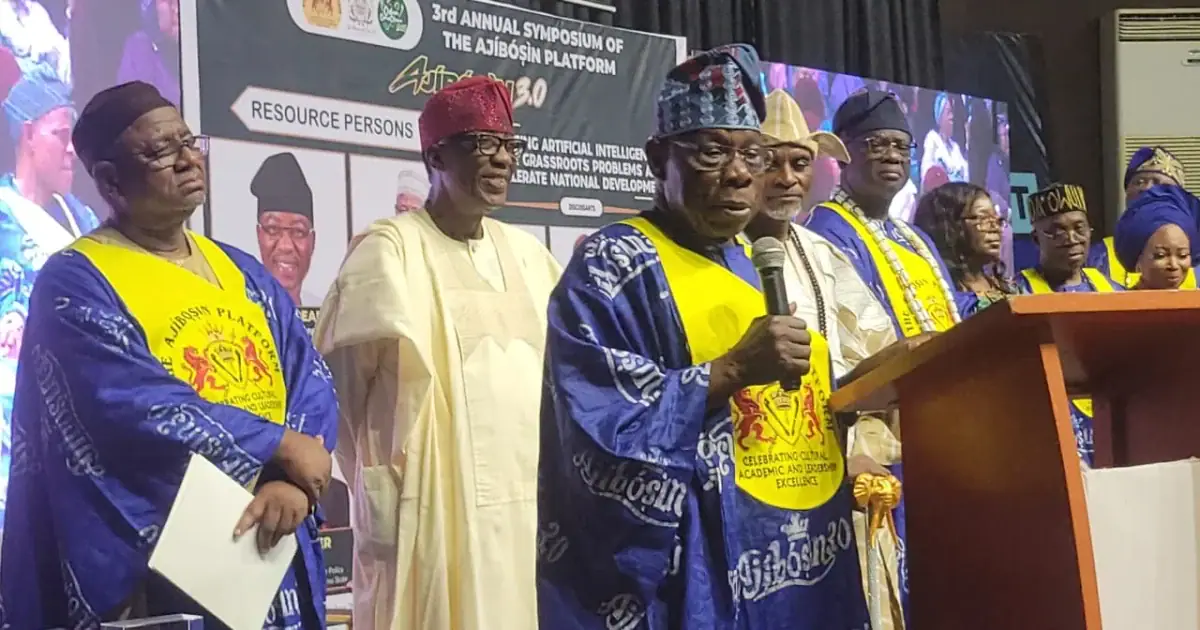
Former President Olusegun Obasanjo has expressed concerns over Nigeria's increasing debt burden, contradicting President Bola Tinubu's recent statement that borrowing is not leprosy. Obasanjo, who secured a landmark $30bn Paris Club debt relief for Nigeria during his administration, stated that excessive borrowing poses a significant threat to the country's future. He made these remarks at the 3rd Ajibosin Annual Symposium in Abeokuta, themed "Leveraging Artificial Intelligence to Solve Grassroots Problems and Accelerate National Development".
Obasanjo described Tinubu's argument as "absolute nonsense," emphasizing that while leprosy affects an individual, debt can have far-reaching consequences for entire generations. He questioned the country's increasing debt burden and the capacity of its leaders to manage the economy effectively. The former President also criticized the policies of the World Bank and the International Monetary Fund, arguing that they are not designed to promote Nigeria's national development and prosperity.
The former President shared his experience of discussing agricultural subsidies with the former Prime Minister of Britain, Jimmy Callaghan. Obasanjo noted that the World Bank and IMF required countries to avoid subsidizing agriculture to receive funding, which he believes hinders national development. He expressed concerns that these institutions, established before Nigeria's independence, dictate policies that may not align with the country's interests.
Obasanjo also lamented the decline of the naira's value, citing a significant depreciation over the past 47 years. He questioned what Nigeria had achieved in that period to warrant such a drastic change. The former President emphasized that debt is worse than leprosy because it affects not just individuals but generations to come.
The former President warned against the unchecked adoption of artificial intelligence and other technologies, cautioning that innovations introduced by powerful foreign countries could become instruments of exploitation if Africans fail to take control of them. Obasanjo stressed that Nigeria must determine how artificial intelligence would serve its development priorities rather than allow foreign interests to dictate the country's technological and economic direction.
Historian and political commentator Dr. Umar Ardo, who delivered a lecture at the symposium, warned that Africa risks becoming a victim of a new form of economic exploitation through AI if the continent fails to take control of its data, technological infrastructure, and intellectual property. Ardo noted that AI offers enormous opportunities for economic transformation and national development but emphasized the need for adequate safeguards and local capacity to harness these benefits.
Ardo highlighted the historical pattern of Africa being exploited through various forms of extraction, from the transatlantic slave trade to colonialism and post-independence dependency. He cautioned that the adoption of AI without ownership and control could perpetuate unequal economic relationships, emphasizing the need for Africa to take charge of its data and technological infrastructure to avoid being exploited.
Key points
- Obasanjo criticizes Tinubu's debt stance, warning that unchecked borrowing endangers future generations.
- The former President questions the policies of the World Bank and IMF, arguing they hinder national development.
- Obasanjo and Ardo emphasize the need for Africa to take control of its data, technological infrastructure, and intellectual property to avoid exploitation through AI.