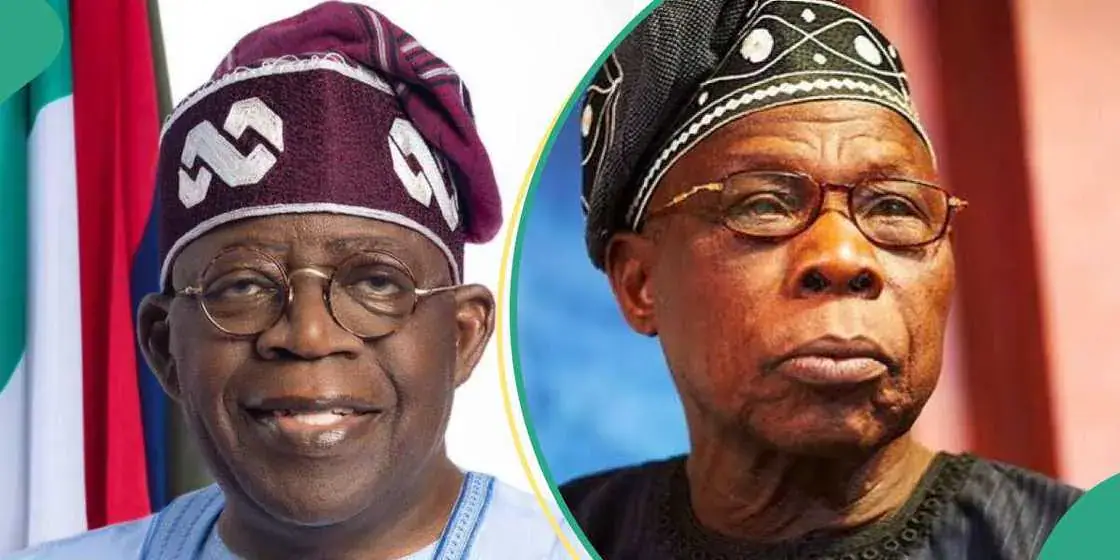
On October 30, 2026, former President Olusegun Obasanjo spoke out against President Bola Tinubu's stance on borrowing, describing it as "absolute nonsense." Obasanjo's comments were made at the Ajibosin Platform in Abeokuta, Ogun State, in response to Tinubu's assertion that "borrowing is not leprosy." Obasanjo argued that excessive borrowing could have severe consequences, affecting not just individuals but generations to come.
President Tinubu had recently requested the National Assembly to approve a supplementary external borrowing plan of $20.52 billion and €1.04 billion to finance various projects and programs across several sectors, including infrastructure, agriculture, healthcare, education, and security. This move has sparked renewed public attention to Nigeria's rising debt profile, particularly with the 2027 general elections approaching.
A Facebook page, Naija Boss, claimed that Obasanjo urged Nigerians to reject Tinubu's second-term bid due to excessive borrowing. The post garnered significant attention, with over 2,000 likes, 103 comments, and 522 shares as of November 9, 2026. However, DUBAWA's fact-checking revealed that Obasanjo's criticism targeted the government's debt policy, not Tinubu's presidency or second-term ambition.
Obasanjo's criticism of Tinubu's borrowing policy was reported by credible media organizations, including The Guardian Nigeria, Punch Newspapers, and ThisDayLive. In his remarks, Obasanjo stated that debt "destroys generations," emphasizing the potential long-term damage of excessive borrowing. However, there is no credible evidence to suggest that Obasanjo called on Nigerians to reject Tinubu or his second-term ambition.
The claim that Obasanjo urged Nigerians to reject Tinubu over borrowing has been deemed misleading. While Obasanjo expressed concerns about the country's debt policy, his comments did not extend to urging Nigerians to vote against Tinubu. The Facebook post by Naija Boss appears to have misrepresented Obasanjo's stance, sparking mixed reactions from users.
DUBAWA's investigation found that Obasanjo's focus was on the potential consequences of excessive borrowing, not on Tinubu's presidency. The fact-checking organization concluded that the claim circulating on social media was misleading and did not accurately reflect Obasanjo's comments.
The development highlights the ongoing debate about Nigeria's debt profile and the need for responsible borrowing practices. As the country prepares for the 2027 general elections, citizens and policymakers continue to scrutinize the government's financial management and borrowing policies. Key points include Obasanjo's criticism of Tinubu's borrowing policy, the government's plans for supplementary external borrowing, and the need for transparency in financial management.
Key points
- Obasanjo criticizes Tinubu's borrowing policy, warning of generational damage.
- No credible evidence suggests Obasanjo urged Nigerians to reject Tinubu.
- The claim circulating on social media has been deemed misleading.