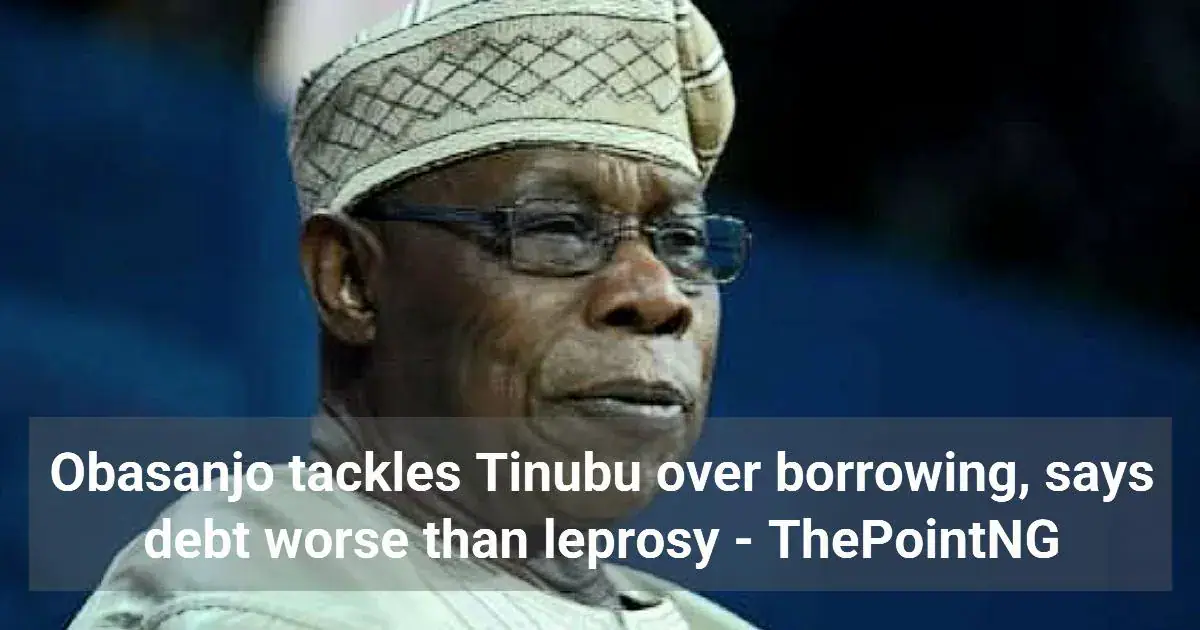
Former President Olusegun Obasanjo has expressed concerns over Nigeria's mounting debt, describing it as worse than leprosy. He faulted President Bola Tinubu's position that borrowing is not a disease, warning that unsustainable debt burdens could affect the entire nation and its future generations. Obasanjo made these remarks at the third Ajibosin Annual Symposium, themed "Leveraging Artificial Intelligence to Solve Grassroots Problems and Accelerate National Development," held at the Olusegun Obasanjo Presidential Library in Abeokuta, Ogun State.
Obasanjo, who secured a $30bn Paris Club debt relief for Nigeria during his administration between 1999 and 2007, questioned the country's rising debt profile and the capacity of its leaders to manage the economy. He dismissed Tinubu's position as "absolute nonsense," emphasizing that while leprosy affects an individual, unsustainable debt burdens an entire nation and its future generations. Obasanjo also criticized the policies of the World Bank and the International Monetary Fund (IMF), arguing that their recommendations were not necessarily designed to advance Nigeria's development and prosperity.
The former President cited agricultural subsidies in Britain as an example, recalling an encounter with former British Prime Minister Jimmy Callaghan, who received government support for his sheep farming business. Obasanjo questioned why Nigeria should be discouraged from subsidizing agriculture simply because the World Bank and IMF opposed such policies. He argued that decisions about Nigeria's development should not be dictated by foreign-trained experts who lack an understanding of the country's peculiar circumstances.
Obasanjo expressed concern over the continued depreciation of the naira, questioning what the country had achieved economically over the past 47 years. Recalling that the naira once exchanged at about $1.85, he lamented that the exchange rate had deteriorated to approximately N1,500 to the dollar. Obasanjo asked, "What has Nigeria done in 47 years that we now have N1,500 naira to the dollar?"
The former President cautioned Nigeria against adopting artificial intelligence and other emerging technologies without adequately understanding their implications. He warned that technologies developed by powerful foreign countries could become tools of exploitation if African nations failed to establish control over their deployment and benefits. Obasanjo maintained that Nigeria must determine how AI would address its development challenges rather than allow foreign interests to dictate its technological and economic priorities.
Historian and political commentator Dr. Umar Ardo also warned that Africa risked becoming a victim of another form of economic exploitation if it failed to control its data, technological infrastructure, and intellectual property in the age of artificial intelligence. Ardo acknowledged AI's potential to transform economies and accelerate development but warned that adopting the technology without ownership, local expertise, and adequate safeguards could reinforce existing economic inequalities.
Obasanjo and Ardo's remarks highlight the need for Nigeria and Africa to be cautious in their adoption of foreign economic prescriptions and emerging technologies. The country's dependence on imported refined petroleum products despite being a major crude oil producer, as well as the reliance of cocoa-producing countries on foreign manufacturers for finished chocolate products, has been cited as evidence of the need for a more self-sufficient economic approach.
Key points
- Obasanjo criticizes Nigeria's rising debt profile and dependence on foreign economic prescriptions.
- The former President warns that excessive borrowing could jeopardize the country's future.
- Obasanjo and Ardo emphasize the need for Nigeria and Africa to control their data, technological infrastructure, and intellectual property in the age of artificial intelligence.