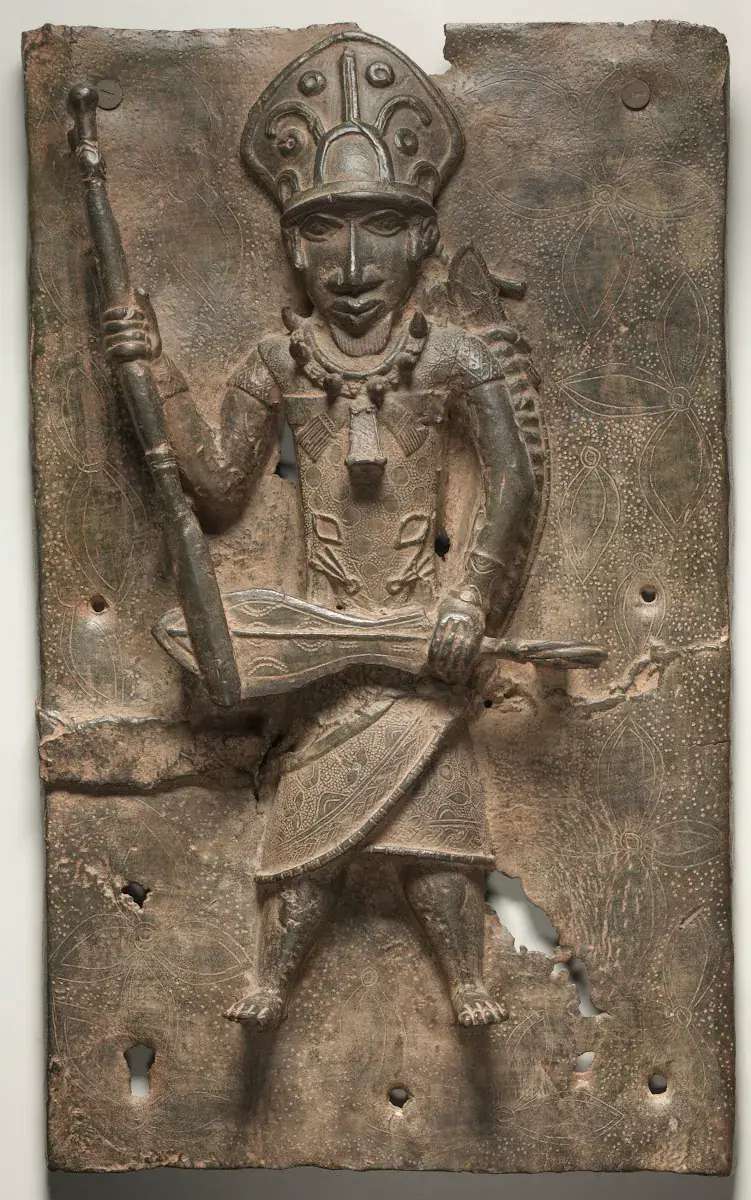
Oba Ozolua, a renowned king of Benin Kingdom, is credited with leading numerous military campaigns that expanded the kingdom's territory and established its reputation as a military power. According to historical records, Ozolua personally commanded his armies, sometimes undertaking two campaigns in a year. His wars extended across Esanland and into neighboring territories, bringing captives and tribute to Benin. The military organization that sustained these expeditions and the demands imposed on the people who supplied the kingdom's fighting forces are also well-documented.
Ozolua's military activity earned him the name Ozolua n'Ibaromi, translated as Ozolua the Conqueror. Historian Alan Frederick Ryder describes his armies as being in almost continuous action, with some accounts suggesting that he led over 200 victorious battles. However, historians Peter M. Roese and Dmitri M. Bondarenko caution that the traditional figure of 200 may express a very large number of victories without functioning as an exact count. The extent of the fighting is difficult to reconstruct precisely, but it is clear that Ozolua's military campaigns played a significant role in Benin's history.
Ozolua inherited a tradition of royal military command from his father, Oba Ewuare, who ruled Benin in the middle decades of the fifteenth century. Ewuare personally commanded his forces and established Benin's reputation as a military power, expanding its territory through campaigns against surrounding communities. Ryder credits Ewuare with strengthening Benin's capital through the construction of defensive earthworks, including the great inner wall and ditch, which were built for military purposes.
The organization of Benin's army developed alongside these changes, operating within the hierarchy of the monarchy, the town chiefs, and the palace chiefs. Osarhieme Benson Osadolor, in his 2001 doctoral dissertation, examines the military reforms attributed to Ewuare and the subsequent expansion of the kingdom under Ozolua. He explains that Benin's military organization assigned responsibilities to different categories of chiefs, with the senior titled institutions possessing considerable political authority.
Ozolua's accession restored a monarch who took personal responsibility for commanding soldiers on campaign, following a period of approximately three years without a reigning monarch. The government had failed to maintain order, and the chiefs struggled to organize the military units necessary to defend the capital during the interregnum. Ozolua's military leadership included officials who possessed both political and military duties, with his most trusted general being Laisolobi, also known as Elaisolobi.
Egharevba describes Ozolua as engaging in warfare at intervals of approximately six months, marching against towns and villages, and sometimes remaining in the field for months before achieving submission. The campaigns were directed against communities that resisted Benin's authority, as well as territories beyond the kingdom's existing area of control. Ryder gives a similar picture of the frequency of warfare, describing Benin's armies as being kept active throughout much of Ozolua's reign.
Ozolua's reputation as a warrior was a significant factor in his military successes, according to Ryder. The strength of Benin's forces and divisions among opposing communities also contributed to his victories. However, Ozolua encountered resistance severe enough to interrupt his campaigns, including at least one major defeat. Despite this, his military campaigns had a lasting impact on Benin's history, establishing its reputation as a military power and expanding its territory.
Key points
- Oba Ozolua led over 200 victorious battles, expanding Benin Kingdom's territory and establishing its military reputation.
Reporting sources
- War After War: Inside Oba Ozolua's Military Campaigns · Prime 9ja Online