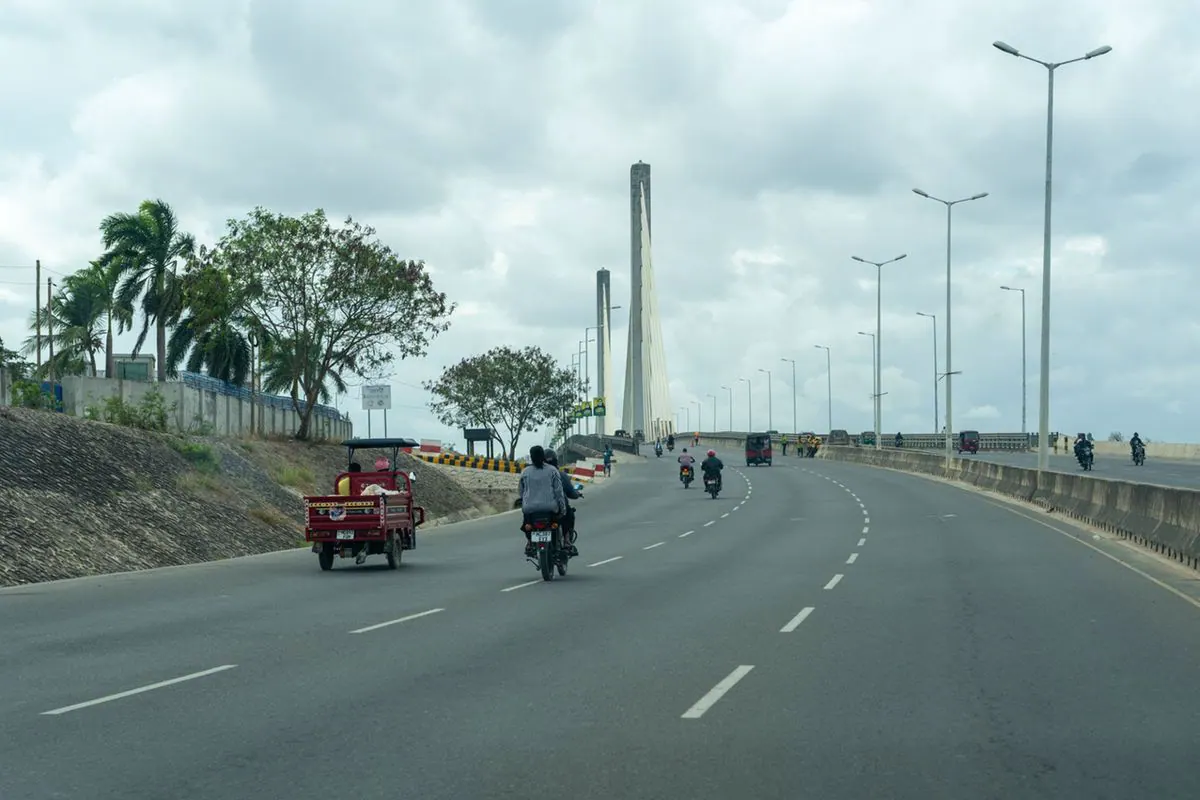
The Nyerere Bridge, also known as the Kigamboni Bridge, has been a subject of discussion in Tanzania due to its unique financing arrangement. The bridge was constructed at a cost of Sh345.20 billion, with Sh328.74 billion used for construction and Sh16.46 billion for land acquisition, compensation, and relocation of project-affected persons. The project was a partnership between the Government of Tanzania, which contributed 40 percent, and the National Social Security Fund, which contributed 60 percent.
The bridge is a toll bridge, with the cost of its construction to be recouped through charging road tolls for bridge users. According to the Director General of the National Social Security Fund, the recovery of the investment would be realized in 30 years from May 2016. With 10 years having gone by, bridge users still have 20 years to go. Out of the Sh150.04 billion collected from tolls, Sh25.81 billion has been used to meet administrative and maintenance costs.
The financing arrangement of the Nyerere Bridge has been classified as a Public-Private Partnership joint venture. However, it has been argued that it is technically a hybrid or public-sector-backed institutional arrangement rather than a true commercial concession PPP. This is because the equity financing came from the state-run National Social Security Fund and the Government of Tanzania, rather than a private consortium.
A Public-Private Partnership is a long-term contractual arrangement between a government entity and a private sector company to finance, build, and operate public infrastructure or services. The Nyerere Bridge arrangement does not fit the traditional definition of a PPP, as it involves two public entities rather than a private sector company. Despite this, it has utilized a PPP financing tool concept, with user tolls paying back institutional capital.
The use of pensioners' money to fund the bridge has raised questions about the refunding of the investment. Pension funds need robust investment avenues to safeguard the interests of their clients, the pensioners. The National Social Security Fund's 60 percent stake in the project essentially acted as a heavy long-term institutional loan, backstopped or partnered with the government.
There are various PPP models that have been developed over time, including concession models, user-pays/user fee models, availability payments models, and Joint Venture models. The Nyerere Bridge project has utilized a user-pays/user fee model, where the projects are funded by the direct users of the infrastructure, such as bridge tolls.
While the Nyerere Bridge is not a true PPP, it offers some lessons to reckon with, particularly the need to strengthen the legal, institutional, and political frameworks to minimize the financial and economic risks that private investors may be exposed to. The project's success or failure will have implications for future infrastructure development in Tanzania.
Key points
- The Nyerere Bridge was constructed at a cost of Sh345.20 billion through a partnership between the Government of Tanzania and the National Social Security Fund.
- The bridge is a toll bridge, with the cost of its construction to be recouped through charging road tolls for bridge users over a period of 30 years.
- The financing arrangement of the Nyerere Bridge has been classified as a quasi-PPP, with the government and the National Social Security Fund contributing 40 percent and 60 percent, respectively.