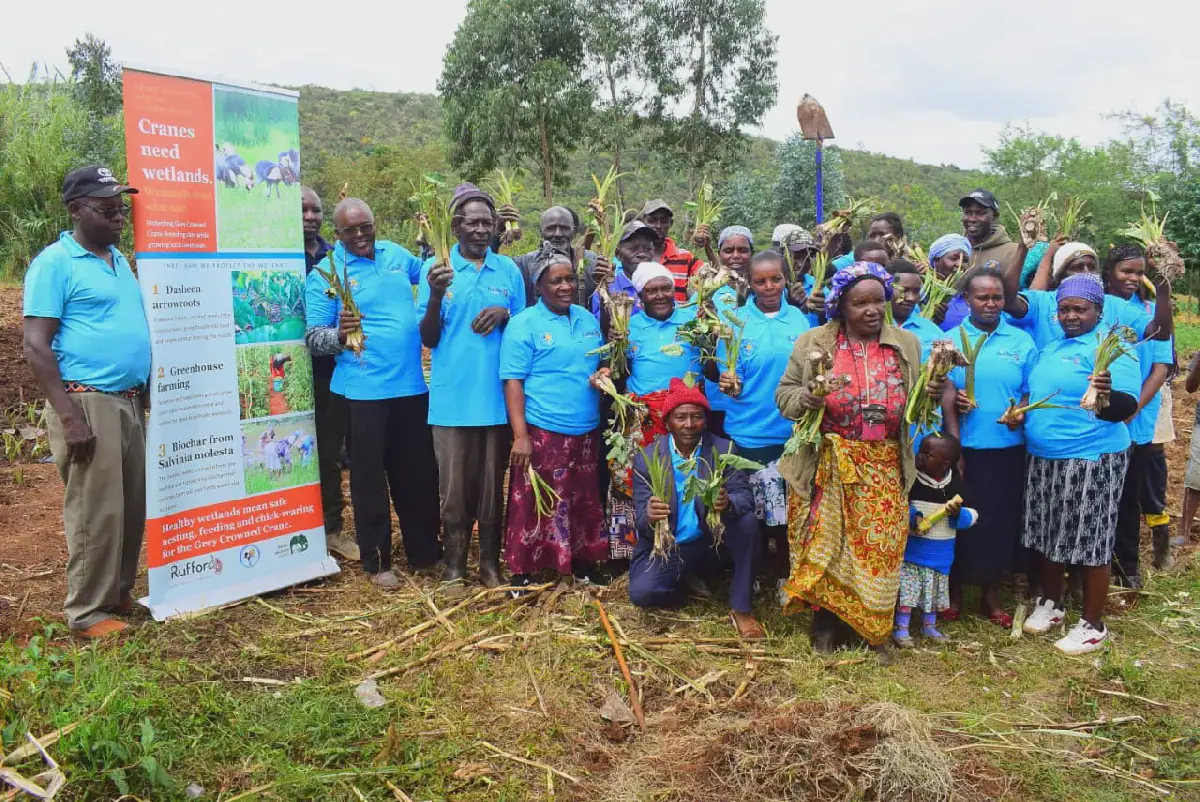
In Nyandarua, Kenya, farmers are shifting from traditional indigenous arrowroot cultivation in wetlands to the Dasheen arrowroot variety, which requires less water and can thrive on upland farms. This change aims to reduce habitat loss for aquatic species and the endangered Grey Crowned Crane. For years, local growers have relied on wetland cultivation, contributing to environmental degradation. The new approach is expected to promote sustainable agriculture and conserve the region's ecosystems.
Conservation experts, such as David Warui of Cranes Conservation Volunteers, recommend the Dasheen variety due to its water efficiency and potential to deliver higher incomes. Warui suggests that modern techniques, including organic soil enrichment and low-labour methods, can enable multiple harvests without encroaching on fragile wetlands. This approach allows agriculture and nature to coexist, promoting a balance between food production and ecosystem conservation.
A project funded by the UK-based Rufford Foundation, in partnership with Cranes Conservation Volunteers, supports the shift to Dasheen arrowroot cultivation. The project provides technical assistance and farming equipment to help farmers transition from wetland to upland cultivation. This initiative aims to empower local farmers economically while promoting environmentally friendly agricultural practices.
Unlike the indigenous arrowroot variety, which requires marshy conditions and a nine-to-thirteen-month growth cycle, Dasheen adapts to upland and moderately wet soils and matures in five to eight months. This allows for earlier harvests and increased productivity. Local farmer Judy Wambui notes that the new variety challenges the traditional belief that arrowroots can only grow in marshes, opening opportunities for sustainable cultivation near homes.
Experienced Dasheen grower Francis Mathaai reports a significant increase in income and notes that previously degraded wetlands in his area are gradually recovering. The adoption of Dasheen arrowroot has not only improved the livelihoods of local farmers but also contributed to the conservation of the region's ecosystems. This shift towards sustainable agriculture is seen as a positive step towards mitigating the impacts of climate change.
The Dasheen arrowroot initiative serves as a model for climate-smart agriculture, balancing food production, economic empowerment, and ecosystem conservation. By adopting water-efficient crops and sustainable agricultural practices, farmers in Nyandarua can reduce their environmental footprint while improving their incomes. This approach can be replicated in other regions facing similar environmental challenges.
The success of the Dasheen arrowroot project in Nyandarua highlights the importance of collaboration between conservation organizations, farmers, and local communities in promoting sustainable agriculture and ecosystem conservation. With continued support and investment, this initiative can have a lasting impact on the region's environmental sustainability and the livelihoods of local farmers.
Key points
- Dasheen arrowroot requires less water and can thrive on upland farms, reducing pressure on fragile wetland habitats.
- The project, funded by the Rufford Foundation, provides technical assistance and farming equipment to support the transition to Dasheen arrowroot cultivation.
- The adoption of Dasheen arrowroot has improved the livelihoods of local farmers and contributed to the conservation of the region's ecosystems.
Reporting sources
- Nyandarua farmers adopt upland Dasheen arrowroot to protect wetlands · kenya-today.com