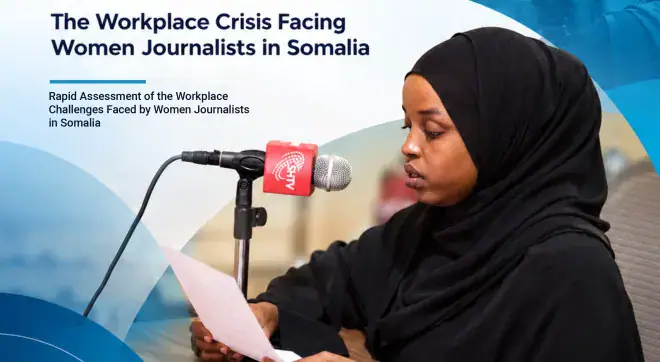
A recent survey conducted by the National Union of Somali Journalists (NUSOJ) has shed light on the harsh realities faced by women journalists in Somalia. The report, titled "Unsafe, Underpaid and Unheard: The Workplace Crisis Facing Women Journalists in Somalia," was released on November 2, 2026, to mark the International Day to End Impunity for Crimes against Journalists. The survey gathered responses from 127 women journalists, and discussions were held with 41 women journalists and 12 media owners and managers.
According to the report, only 10% of women journalists surveyed in Somalia felt safe at work, while 52% reported feeling unsafe or very unsafe. Nearly half of the respondents, 48%, stated that they had experienced harassment during their careers, with many reporting incidents in newsrooms, on field assignments, and online. The report also found that 45.7% of respondents chose not to answer the question about harassment.
Job insecurity and irregular pay are also widespread issues faced by women journalists in Somalia. The survey revealed that only 49.6% of respondents had written employment contracts, and a mere 26% had full-time contracts. More than half of the respondents reported chronic salary arrears, irregular payments, or working without pay. This has resulted in significant financial uncertainty for many women journalists.
Career progression remains limited for women journalists in Somalia. Only 11% of respondents believed they had the same opportunities as men to advance in their careers. A significant 46.5% of respondents reported being denied a promotion or key assignment due to their gender. Furthermore, nearly two-thirds, 63.8%, of respondents stated that they had received no workplace training.
NUSOJ Secretary-General Omar Faruk Osman condemned the injustices faced by women journalists, stating that they endure violations of rights and failures of employer responsibility. Osman emphasized that women journalists face greater risks and lack protection in their own workplaces, highlighting the need for urgent action to address these issues.
In response to the findings, NUSOJ has called on media organizations to take concrete steps to improve the working conditions of women journalists. The union has urged media owners to provide written contracts, pay wages on time, establish independent complaints systems, and ensure women have equal access to training and leadership opportunities.
The report was produced by NUSOJ with support from the United Nations Development Programme (UNDP), funded by the European Union (EU). Somalia ranks 126 out of 180 countries in the World Press Freedom Index, and journalists in the country work in an environment of great insecurity, according to Reporters Without Borders. With over 50 media professionals killed since 2010, Somalia remains one of the most dangerous countries for journalists in Africa.
Key points
- Women journalists in Somalia face widespread harassment, job insecurity, and discrimination.
- Only 10% of women journalists surveyed in Somalia felt safe at work.
- NUSOJ has called on media organizations to improve working conditions for women journalists.