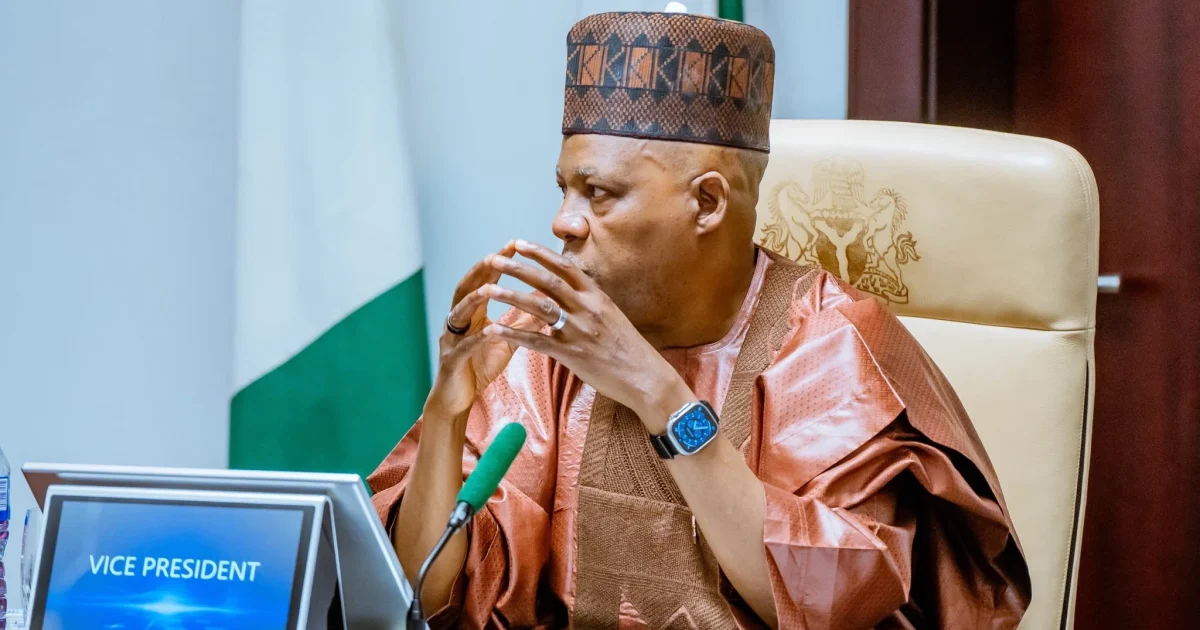
Vice President Kashim Shettima has stated that Nigeria's oil blocks are now awarded through open and competitive processes, citing a friend who secured an upstream asset without using political connections. Representing President Bola Tinubu at the Nigerian Upstream Petroleum Regulatory Commission's (NUPRC) fifth anniversary in Abuja, Shettima highlighted the transparency of reforms in the upstream oil sector. The NUPRC was established in 2021 to regulate the sector and oversee petroleum resources.
Shettima emphasized that the Federal Government is committed to making Nigeria a preferred destination for long-term hydrocarbon investment, assuring investors of clear terms and enforcement of compliance and accountability. The government's reforms aim to attract fresh investment into the oil and gas industry, improve crude oil production, and reduce barriers discouraging investors from developing Nigeria's petroleum resources. The NUPRC has conducted licensing and bidding processes, including the 2024/2025 oil licensing round.
The Petroleum Industry Act (PIA) of 2021 ended years of uncertainty in the industry by establishing clearer rules for investors and giving host communities a greater stake in petroleum-producing areas. Shettima credited Senator Ahmed Lawan for shepherding the passage of the PIA Bill, noting that it provided investors with clear rules and a predictable framework. The PIA has consolidated Nigeria's position as Africa's leading destination for investment in the oil and gas sector for two consecutive years.
Shettima highlighted that Nigeria has moved from a period of significant crude production loss due to theft and vandalism to a situation where output is becoming more stable. The joint efforts of security agencies, operations, host communities, and the NUPRC have contributed to steady and stronger production. Investors who previously looked elsewhere are returning, and Nigeria has been ranked Africa's leading destination for investment in the sector for two years.
The Vice President also emphasized the role of host communities in maintaining stability in oil-producing areas, noting that over 170 communities have benefited from projects covering education, healthcare, and other areas selected by the communities. The Federal Government is working to address the high cost and lengthy contracting processes that have discouraged investment in the sector. Several presidential directives and executive orders have been introduced to improve the fiscal and regulatory environment.
Shettima mentioned the Deep Offshore Oil and Gas Project Incentive Tax Remission Order 2026, designed to unlock up to $50bn in new investment, starting with the Bonga South-West project. The order replaces the unsettled process with clear criteria, providing a predictable framework for investors. The Vice President charged the NUPRC to maintain transparency, ensure predictable timelines, and work with other government agencies to eliminate regulatory conflicts.
The government will continue to pursue reforms aimed at making Nigeria a preferred destination for long-term hydrocarbon investment while using oil and gas revenues to support broader economic diversification. Shettima added that the government will prioritize gas development, leveraging Nigeria's large gas reserves to support electricity generation, industrial growth, and a cleaner energy transition. The NUPRC has an important role in translating government policy into actual investment and production.
Key points
- Nigeria's oil blocks are now awarded through open and competitive processes.
- The Petroleum Industry Act has consolidated Nigeria's position as Africa's leading destination for investment in the oil and gas sector.
- The government aims to unlock up to $50bn in new investment through the Deep Offshore Oil and Gas Project Incentive Tax Remission Order 2026.