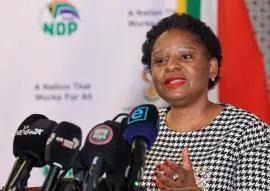
South Africa's Broad-Based Black Economic Empowerment (B-BBEE) policy continues to play a vital role in addressing the economic injustices of Apartheid, according to Minister in the Presidency Khumbudzo Ntshavheni. Apartheid was declared a crime against humanity, and its economic impacts were severe, with families forcibly removed from their land and workers barred from skilled jobs by law. The policy aims to provide redress, and Ntshavheni emphasized that it is a constitutional obligation, not a bargaining chip.
The B-BBEE policy has led to significant progress, with 3.4 million black South Africans now part of a middle class that their parents were previously barred from, with an estimated R400 billion in annual spending power. According to the Broad-Based Black Economic Empowerment Amendment Act, the policy aims to empower all black people, particularly women, workers, youth, people with disabilities, and those living in rural areas. The Act outlines various strategies, including increasing the number of black people managing, owning, and controlling enterprises and productive assets.
The Youth Employment Service, created under the B-BBEE framework, has provided 240,000 young people with a full year of paid work, resulting in R15 billion in salaries earned. More than half of these young workers are women. Additionally, Equity Equivalent Investment Programmes have led to the creation of over 2,000 jobs, supported 87 black-owned businesses, and trained more than 2,500 people. These programs allow multinationals to invest in socio-economic development without selling equity in their local subsidiaries.
President Cyril Ramaphosa introduced the Equity Equivalent Investment Programmes in June last year to accommodate multinationals whose global practices prevent them from complying with the B-BBEE ownership element. The program enables multinationals to invest in skills and enterprise development in South Africa without selling local equity. Companies such as Dell, Microsoft, and HP have complied with B-BBEE through these programs, investing in black-owned businesses and skills development.
Ntshavheni emphasized that the progress made through B-BBEE has not come at the expense of white South Africans, who continue to prosper in the economy. However, 23.1 million black South Africans remain outside of the economic prosperity, with a significant income disparity between black and white workers. The Minister stressed that abandoning redress now would be to tell these South Africans that their freedom ends at the ballot box.
The Minister clarified that B-BBEE is not a precondition for investing in South Africa and applies where a company requires a license from the state, such as in mining and ICT. Multinationals can comply through Equity Equivalent Investment Programmes if their policies prevent them from selling local equity. Ntshavheni also highlighted South Africa's commitment to non-discrimination and the rules-based World Trade Organization.
Ntshavheni explained that the Department of Trade, Industry and Competition engages with investors on individual transactions, outlining the policy's requirements and flexibilities. The B-BBEE Codes provide a framework for sectors to negotiate their flexibilities within agreed-upon frameworks. The Minister concluded that B-BBEE ensures that growth is shared, making it sustainable, and that the country seeks investors who will build processing, beneficiation, and manufacturing capacity on home soil.
Key points
- The B-BBEE policy aims to address Apartheid's economic injustices and promote economic empowerment for black South Africans.
- The policy has led to significant progress, including the creation of 240,000 jobs and R400 billion in spending power for black South Africans.
- The government remains committed to B-BBEE, with a review of the framework underway to strengthen it for transformation and growth.