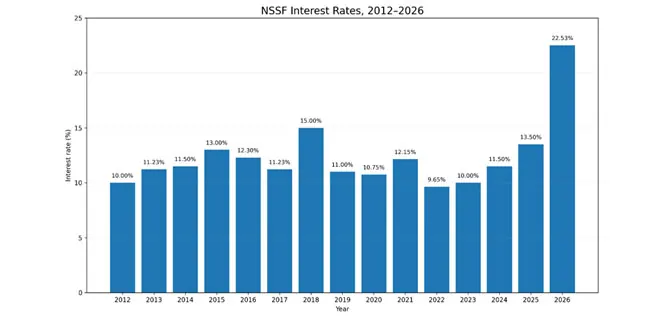
The National Social Security Fund (NSSF) in Uganda has announced a record interest rate of 22.53% for the financial year 2025/26, translating into Sh5.44 trillion to be credited to members' accounts. This is the highest rate and amount in the Fund's history. The announcement was made at NSSF's 14th Annual Members' Meeting in Kampala on September 24. The Fund's assets under management increased from Sh26 trillion to Sh32 trillion, while annual revenue rose 86% to a record Sh6.51 trillion.
NSSF's Managing Director, Patrick Ayota, attributes the record performance to a combination of economic growth, stronger equity markets in East Africa, and favourable currency movements. Member contributions increased 13% to Sh3.4 trillion, while the Fund paid out about Sh1.5 trillion to qualifying members. The Fund's growth has sparked debate over its role in financing economic growth and development projects in Uganda. NSSF is increasingly a source of long-term capital for the economy.
The Fund's investment decisions influence the government securities market, equities, property, and potentially large infrastructure projects. Policymakers are asking whether NSSF should play a larger role in financing projects that can raise productivity and generate economic returns. Minister of Gender, Labour and Social Development, Henry Tumukunde, argues that NSSF must ensure its financial strength is reflected in Uganda's development agenda.
Tumukunde challenges NSSF to move away from a "parastatal style" of management and adopt a private-sector approach. He suggests that appointments should be based on competence rather than academic qualifications alone. This is particularly relevant as NSSF moves into larger and more complex investments. Managing a Sh32 trillion portfolio requires investment expertise, risk management, and governance structures comparable with those of major institutional investors.
NSSF's growth has also raised questions about governance, risk allocation, transparency, and the boundaries between public policy and commercial investment. The Fund's chairman, David Ogong, notes that NSSF's investment choices remain subject to the legal framework governing the Fund. The government wants to increase formal employment and bring more workers into pension schemes to enlarge the country's pool of long-term domestic capital.
Finance Minister Henry Musasizi welcomes NSSF's performance and says the government will continue supporting the Fund as it balances investment with value creation for savers. NSSF plans to increase active membership to 15 million by 2030, while targeting assets of Sh50 trillion and eventually Sh80 trillion by 2035. If these targets are achieved, NSSF's importance to Uganda's capital markets will be significantly greater than it is today.
The record 22.53% interest rate is an extraordinary number, but a single year's return should not become the benchmark by which members judge the Fund indefinitely. Investment markets move in cycles, and what matters ultimately is whether NSSF can generate strong, sustainable risk-adjusted returns over the decades during which members' savings are invested. The Fund's growth presents both opportunities and challenges in balancing investment returns with development goals.
Key points
- NSSF declares record 22.53% interest rate for 2025/26
- Fund's assets under management increase to Sh32 trillion
- Policymakers debate NSSF's role in financing development projects