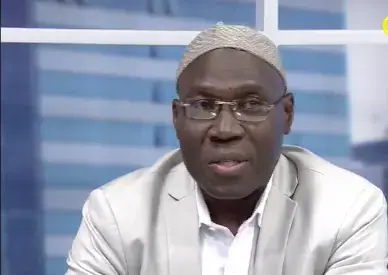
Former Member of Parliament for Tamale Central, Inusah Fuseini, has stated that the New Patriotic Party's (NPP) suit seeking the Supreme Court's interpretation on presidential term limits is needless. According to him, the 1992 Constitution of Ghana is clear on the matter. Article 66(2) of the Constitution limits a person to two terms as President, with no distinction between consecutive and non-consecutive terms.
Mr. Fuseini, a lawyer, explained that the provision aims to limit how many times a person can be elected, not regulate how long someone must stay out of office before running again. He drew a comparison with Parliament, noting that while the Constitution caps presidential terms, it sets no limit on how often an MP can seek re-election. He cited his own experience of serving more than four terms as a legislator.
The lawyer pointed to Article 66(1), which sets a presidential term at four years, and Article 66(2), which states that a person "shall not be elected to hold office as President of Ghana for more than two terms." He emphasized that the Constitution is clear and that the drafters knew what they wanted to achieve by imposing term limits.
Mr. Fuseini questioned the necessity of involving the Supreme Court, stating that it has no jurisdiction to speculate on potential issues. He expressed concern about spending public resources on a case built on a hypothetical situation, emphasizing that there must be a real constitutional issue for the court to decide.
The NPP has sued the Attorney-General, seeking the Supreme Court's interpretation of Articles 58(2) and 66(1), (2), and (3)(a). The party wants the court to affirm that nobody can be elected President more than twice or hold the office for more than eight years, whether the terms run back to back or are separated by time out of office.
Mr. Fuseini's comments come as a former member of the National Democratic Congress. His views are likely to be seen as opposing the NPP's move, which could have significant implications for Ghana's presidential term limits. The Supreme Court's interpretation, if given, could set a precedent for future presidential elections.
The issue of presidential term limits has sparked debate in Ghana's political landscape. While the NPP seeks clarity on the matter, Mr. Fuseini believes that the Constitution is already clear, and the NPP's suit is unnecessary. The Supreme Court's decision, when made, will provide the final word on the matter.
Key points
- The NPP has sued the Attorney-General seeking the Supreme Court's interpretation on presidential term limits.
- Lawyer Inusah Fuseini says the NPP's suit is unnecessary, citing the clarity of the 1992 Constitution.
- The Supreme Court's interpretation could set a precedent for future presidential elections in Ghana.