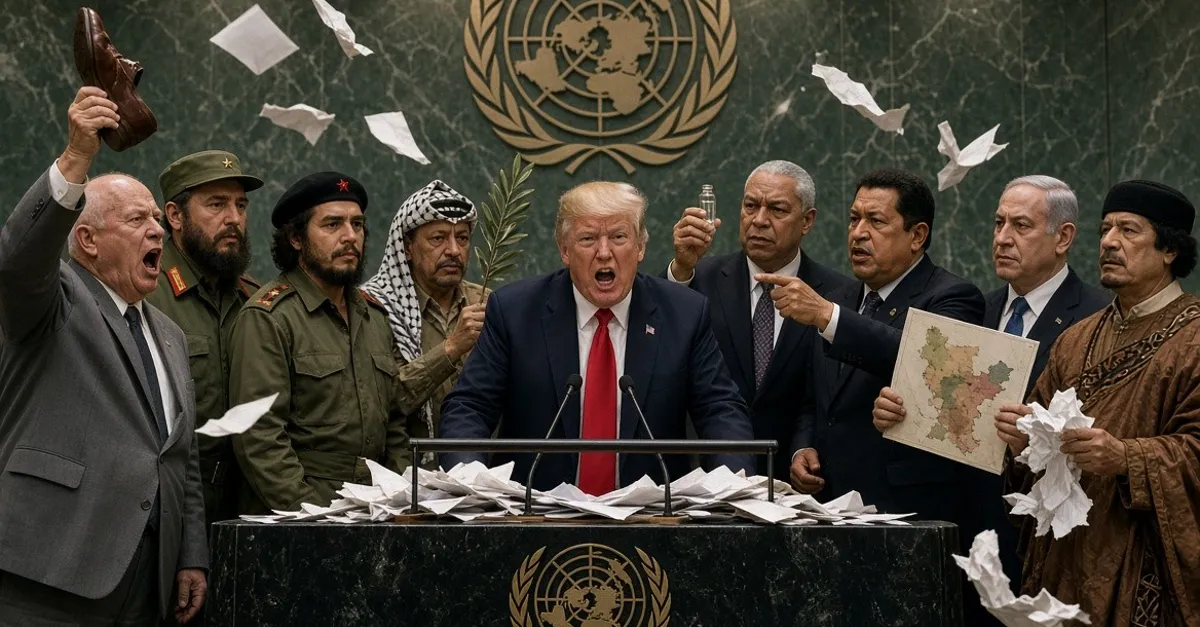
The 81st session of the United Nations General Assembly has commenced, bringing with it a history of dramatic moments that have defined the international organization. One such moment occurred in 1960, when Soviet leader Nikita Khrushchev took the stage, only to have his remarks interrupted by a heated exchange with the Philippine delegate, Lorenzo Sumulong. The tension escalated as Khrushchev removed his shoe and pounded it on the desk, while the session's Irish president, Frederick Boland, slammed his gavel, causing it to break.
The 1960 session was marked by several high-profile confrontations, including an address by Cuban leader Fidel Castro, which lasted 4 hours and 29 minutes, making it the longest speech in the Assembly's history. During his speech, many delegates were seen dozing off, a testament to the lengthy nature of Castro's address. Meanwhile, Ernesto "Che" Guevara, also a prominent Cuban figure, delivered a speech in 1964 that was marked by a bazooka explosion outside the building, which did not deter Guevara from continuing to speak.
The Israeli-Palestinian conflict has also been a source of tension at the UN General Assembly. In 1974, Palestinian leader Yasser Arafat addressed the Assembly, famously stating, "I came to you with an olive branch in one hand and a freedom fighter's gun in the other." A year later, Israeli delegate Chaim Herzog tore apart a resolution equating Zionism with racism, a move that sparked widespread controversy. This confrontation has continued in recent years, with both sides engaging in symbolic gestures to express their positions.
In 2003, US Secretary of State Colin Powell presented a vial of powder as evidence of Iraq's possession of weapons of mass destruction, a claim that was later disputed. The incident has been referred to as a "stain" on Powell's record. In 2006, US President George W. Bush addressed the Assembly, sparking a response from Venezuelan President Hugo Chavez, who accused Bush of speaking as if he were the "master of the world."
The Iranian nuclear program has also been a contentious issue at the UN General Assembly. In 2012, Israeli Prime Minister Benjamin Netanyahu presented a graphic illustration of a nuclear bomb, warning of the dangers of Iran's nuclear ambitions. In 2017, US President Donald Trump referred to North Korean leader Kim Jong-un as "Rocket Man," threatening to destroy North Korea if necessary.
In 2009, Libyan leader Muammar Gaddafi addressed the Assembly, calling for the abolition of the veto power held by permanent members of the Security Council. Gaddafi tore up a copy of the UN Charter, accusing the permanent members of using their veto power to further their own interests. In 2011, Iranian President Mahmoud Ahmadinejad raised the stakes, threatening sanctions and military action against those who questioned the Holocaust and the 9/11 attacks.
The veto power has continued to be a point of contention at the UN General Assembly. In 2022, Russia used its veto power to block a Security Council resolution on Ukraine, leading to a General Assembly vote that condemned Russia's actions. The ongoing debates and confrontations at the UN General Assembly serve as a reminder of the complexities and challenges facing the international community.
Key points
- The UN General Assembly has a long history of dramatic confrontations and tense exchanges between world leaders.
- The Israeli-Palestinian conflict and the Iranian nuclear program have been contentious issues at the UN General Assembly.
- The veto power held by permanent members of the Security Council has been a point of contention, with many calling for its abolition.