The annual inflation rate for September in Namibia stood at 5.4%, a significant decrease from the 3.5% registered in September 2025. On a monthly basis, the inflation rate was recorded at 0.4%, compared to 0.6% registered during the preceding month. Core inflation was observed at 4%, right below the headline inflation rate. This data indicates a fluctuation in the inflation trend in the country.
According to the September zonal inflation figures, Zone 2, which comprises the Khomas Region, recorded the highest annual inflation rate of 6.2%. This was followed by Zone 3, which includes the //Kharas, Erongo, Hardap, and Omaheke regions, registering an annual inflation rate of 5.8%. The varying inflation rates across different zones suggest regional disparities in price changes.
In contrast, Zone 1, which consists of the Kavango East, Kavango West, Kunene, Ohangwena, Omusati, Oshana, Oshikoto, Otjozondjupa, and Zambezi regions, recorded the lowest annual inflation rate at 4.3%. This indicates that the northern regions experienced relatively lower price increases compared to other parts of the country. The data highlights the diversity in inflation rates across different regions.
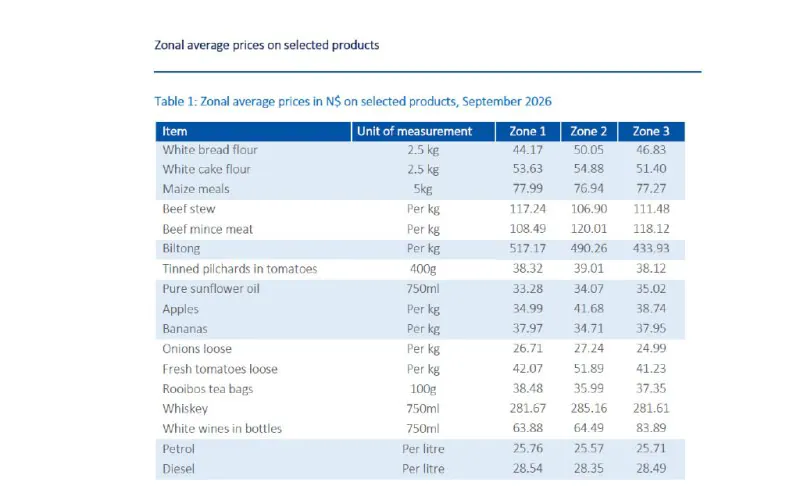
An analysis of average retail prices for selected products in September revealed that consumers in Zone 1 paid the highest average price for petrol, at N$25.76 per litre, followed by Zone 3 at N$25.71 per litre, while Zone 2 recorded the lowest average price at N$25.57 per litre. Similarly, Zone 1 recorded the highest average price for diesel at N$28.54 per litre, followed by Zone 3 at N$28.49 per litre, while Zone 2 recorded the lowest average price at N$28.35 per litre.
Almandro Jansen of Simonis Storm commented on the inflation figures, forecasting a rate of 5.4% in October, 5.7% in November, and 5.8% in December, with a calendar 2026 average of 4.2%. Jansen's forecast reflects the softer September outcome and the diesel freeze. He also predicted that inflation would rise to 5.8% in January and 6.1% in February before peaking at about 6.2% in March 2027.
Jansen further noted that if oil prices remain elevated and the rand weakens, inflation peaks near 7.3% in March 2027 and averages about 6.4% over September 2026 to June 2027, likely requiring more than one further Bank of Namibia repo rate hike. However, if oil prices ease, inflation falls to about 3.0% by June 2027 and averages about 4.6% over the period. His comments suggest that the future inflation trend is highly dependent on global oil prices and exchange rates.
The inflation data and forecasts have significant implications for the country's economic policy and consumer behavior. As the inflation rate continues to fluctuate, consumers and businesses will need to adjust their strategies to mitigate the effects of price changes. The Bank of Namibia will also need to carefully consider the inflation trends when making future policy decisions.
Key points
- The northern regions of Namibia recorded the lowest inflation rate in September at 4.3%.
- The overall inflation rate for September stood at 5.4%, with core inflation observed at 4%.
- The future inflation trend in Namibia is highly dependent on global oil prices and exchange rates.