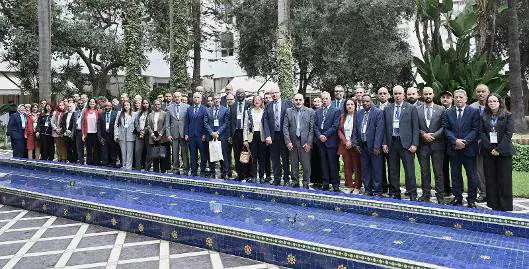
The 41st session of the Intergovernmental Committee of High Officials and Experts (CIHFE) concluded in Rabat, Morocco, on November 5, 2026. The meeting, organized by the United Nations Economic Commission for Africa (UNECA) North Africa Bureau, focused on strengthening economic resilience in the face of global shocks. Participants emphasized the need for North African countries to adopt innovative measures to mitigate and adapt to climate change, including enhanced governance of resources, increased use of renewable energy, and sustainable agricultural practices.
The CIHFE session and an accompanying expert group meeting called for North African nations to adopt strategic planning and prospective approaches to policy development. This includes leveraging green and sustainable finance by developing frameworks, strategies, and financing instruments to achieve climate-resilient and low-carbon development. The use of big data, innovation, and artificial intelligence was also recommended to inform evidence-based policy development and enhance regional cooperation in economic resilience.
The meeting reviewed the achievements of the UNECA North Africa Bureau over the past year and discussed its draft work program and strategic orientations for the upcoming year. National representatives and experts shared experiences and best practices in mitigating the impact of multiple concurrent shocks. Recommendations included calls for member states to implement reforms to preserve macroeconomic stability, build economic resilience, and develop flexible and adaptable budgetary frameworks and resilient financial systems.
Participants also emphasized the importance of improving debt viability, strengthening debt management practices, and enhancing national capacities to manage risks and evaluate financing options. Progressing with the implementation of national strategies for the African Continental Free Trade Area (AfCFTA) and strengthening regional coordination and South-South cooperation were also highlighted. Effective partnerships were seen as crucial in these efforts.
The CIHFE and expert group meeting concluded with recommendations for the UNECA, including conducting analytical work on resilient growth and examining the links between social, economic, and ecological dimensions. The UNECA was also urged to develop strategic tools, such as artificial intelligence, to help member states develop and implement adaptive transition trajectories and support the strengthening of domestic resource mobilization and debt management.
The recommendations from the 41st CIHFE session and the expert group meeting will be submitted to the 59th session of the UNECA and the Conference of Ministers of Finance, Planning, and Economic Development (COM2027) in Addis Ababa, Ethiopia, from March 17 to 23, 2027. The COM2027 conference will focus on "Shaping the Future of Work in Africa: Youth Employment."
The UNECA North Africa Bureau, established in Morocco in 1963, supports seven countries in the region: Algeria, Egypt, Libya, Mauritania, Morocco, Sudan, and Tunisia. Its objective is to contribute to an environment conducive to accelerated and inclusive growth and sustainable development in North Africa.
Key points
- North African countries are urged to adopt strategic planning and prospective approaches to policy development.
- The use of green and sustainable finance is recommended to achieve climate-resilient and low-carbon development.
- Regional cooperation and South-South cooperation are seen as crucial in enhancing economic resilience in North Africa.