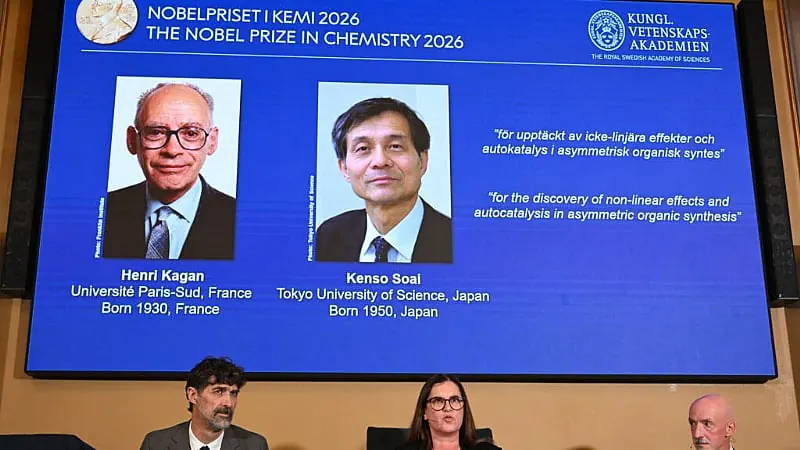
On Wednesday, October 7, 2026, the Nobel Prize in Chemistry was awarded to France's Henri Kagan and Japan's Kenso Soai for their groundbreaking work on asymmetric organic synthesis. The Royal Swedish Academy of Sciences announced the winners at a ceremony in Stockholm, Sweden. Kagan and Soai were recognized for their discovery of non-linear effects and autocatalysis in asymmetric organic synthesis, which has significant implications for the development of pharmaceuticals.
The Nobel laureates' research focused on the phenomenon of homochirality, where only one version of a molecule's mirror-image form appears in nature. Amino acids, the building blocks of proteins, exist as two mirrored variants, but only one is found in the proteins in the body's cells. Chemists have long been puzzled by this process, and Kagan and Soai's discoveries have provided a solution to this century-old mystery.
The Nobel Committee for Chemistry, led by Heiner Linke, praised Kagan and Soai's work, saying their discoveries have enabled chemists to drive chemical reactions that lead to homochirality. The committee described their chemical reactions as "spectacular" and noted that their findings have been decisive for chemists designing reactions for the manufacture of pharmaceuticals.
The Nobel Prize in Chemistry is one of several awards being announced this week. On Monday, the medicine prize was awarded to Karl Deisseroth, Peter Hegemann, and Georg Nagel. The physics prize, announced on Tuesday, went to Belgian physicist Francis Halzen for his work on capturing particles originating in the distant cosmos using Antarctic ice.
The literature laureate will be revealed on Thursday, with some pundits speculating that the Swedish Academy may award the prize to a woman writer from Latin America. The peace prize, which is often highly anticipated, is due to be announced on Friday. The economics prize will wrap up the Nobel season on October 12.
The Nobel Prize consists of a diploma, a gold medal, and a 12-million-kronor ($1.2-million) prize sum, which is shared if there is more than one winner in a discipline. Kagan and Soai will receive their prizes at a formal ceremony on December 10, the anniversary of the death of scientist Alfred Nobel, who created the prizes in his will.
Last year, the chemistry prize was awarded to Japan's Susumu Kitagawa, UK-born Richard Robson, and American-Jordanian Omar Yaghi for developing a method of designing molecular structures. The Nobel Prizes continue to recognize outstanding contributions in various fields, and this year's winners are being honored for their innovative and impactful work.
Key points
- Henri Kagan and Kenso Soai won the Nobel chemistry prize for their discovery of non-linear effects and autocatalysis in asymmetric organic synthesis.
- Their research provided a solution to the mystery of homochirality, where only one version of a molecule's mirror-image form appears in nature.
- The Nobel Prize in Chemistry is one of several awards being announced this week, including the medicine, physics, literature, peace, and economics prizes.