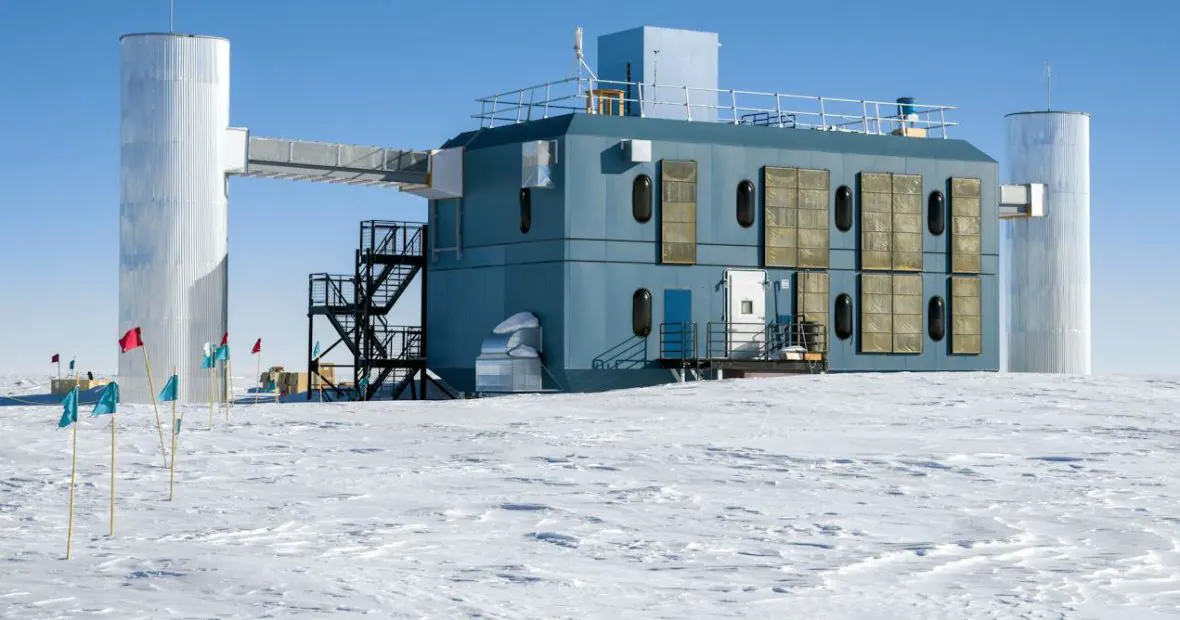
The 2026 Nobel Prize in Physics has been awarded to Francis Halzen, a Belgium-born physicist, for his groundbreaking discovery of high-energy neutrinos from space. The Nobel Committee recognized Halzen's "decisive contributions" to the detection of neutrinos of astrophysical origin using the IceCube experiment, installed under the ice at the South Pole. This achievement has opened a new window into the universe, allowing scientists to study extreme environments that are invisible to light.
Halzen's work involves the detection of high-energy neutrinos that originate from distant sources, such as black holes at the hearts of galaxies. These neutrinos are extremely rare, occurring at a rate of about one billion times less than those emitted by the Sun. The IceCube experiment, comprising thousands of sensors under the Antarctic ice, captures the faint flashes of these high-energy particles. This has enabled scientists to study the properties of neutrinos and their role in astronomy.
The concept of using the Antarctic ice as a natural detector was proposed by Halzen in 1988. The ice's exceptional clarity allows scientists to drill narrow boreholes and lower light sensors, which become embedded in the ice. When a neutrino collides with matter in or near the ice, it produces a charged particle that creates a faint cone of blue light, known as Cherenkov radiation. By measuring the timing and pattern of this light, IceCube can reconstruct the particle's path and infer the direction of the original neutrino.
The breakthrough achieved by Halzen and the IceCube team has significant implications for astronomy. Neutrinos behave differently from other particles, such as cosmic rays, which are electrically charged and have their paths bent by magnetic fields. Neutrinos, on the other hand, travel in almost straight lines, allowing scientists to pinpoint their source in the sky. This has led to the development of multi-messenger astronomy, which combines different cosmic signals to build a fuller picture of the universe.
The discovery of high-energy neutrinos has also shed light on some of the most violent places in the universe, including the surroundings of supermassive black holes and powerful cosmic particle accelerators. The ability to detect these neutrinos has provided a new tool for scientists to study these extreme environments. According to Mark Pearce, chair of the Nobel Committee for Physics, "The neutrino has such peculiar properties... that it's a way of bringing us information about distant cosmic sources that we are unable to acquire in other ways."
Halzen's work adds another chapter to the study of neutrinos, which have been recognized by several Nobel Prizes in the past. His achievement demonstrates the potential of neutrinos as messengers from the cosmos, allowing scientists to study the universe in new and innovative ways. While the idea of using neutrinos for interstellar communication remains hypothetical, the discovery of high-energy neutrinos has opened up new possibilities for understanding the universe.
The IceCube experiment, located at the South Pole, has been instrumental in detecting high-energy neutrinos. The experiment's success is a testament to Halzen's insight and perseverance. Ellen Moons, secretary general of the Royal Swedish Academy of Sciences, referred to these neutrinos as "ghostly messengers," highlighting their elusive nature and the challenges of detecting them. Despite these challenges, Halzen's work has paved the way for a new era in astronomy, one that leverages the unique properties of neutrinos to explore the universe.
Key points
- Francis Halzen wins 2026 Nobel physics prize for detecting high-energy neutrinos from space using IceCube experiment
- The discovery of high-energy neutrinos has opened a new window into the universe, allowing scientists to study extreme environments that are invisible to light
- The IceCube experiment, located at the South Pole, has been instrumental in detecting high-energy neutrinos and has paved the way for a new era in astronomy