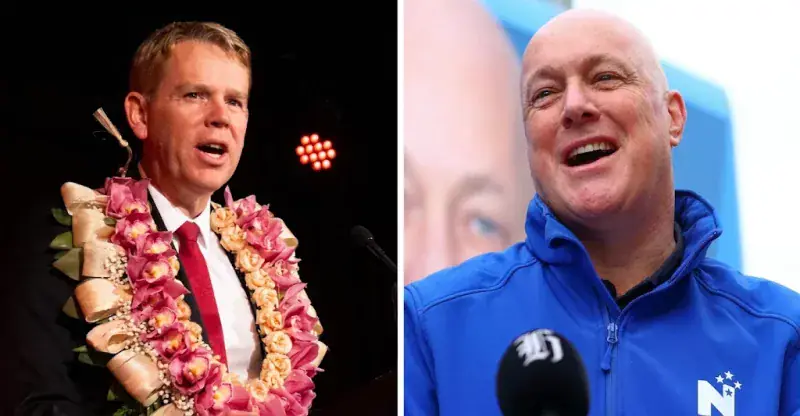
New Zealand's general election has ended without a clear winner, with Prime Minister Christopher Luxon's centre-right National Party securing 42 seats, 19 short of the simple majority needed to form a government. The National Party, despite being the largest party, will have to negotiate with other parties to form a coalition government. Preliminary results show that the party has a slim lead over the left-leaning bloc when combined with its coalition partners ACT and New Zealand First.
The opposition leader, Chris Hipkins, whose Labour Party won 36 seats, has shown no signs of conceding, stating that the "shape of the next government" will remain uncertain "for a while". The tight result follows a campaign focused on the cost of living and unemployment. Hipkins congratulated Luxon on a "very hard-fought race" but emphasized that the next parliament will require compromise and cooperation to find common ground.
The electoral commission is not expected to announce the official result until November 27. More than 99% of votes have been counted, with National and Labour neck-and-neck in terms of vote share. However, the preliminary results indicate historically low support for the two major parties, with a combined vote share of around 60%. The Greens, ACT, New Zealand First, and Te Pāti Māori also secured seats in parliament.
The Opportunity Party, a centrist party, has crossed the 5% threshold to enter parliament for the first time. The party's leader, Qiulae Wong, has stated that they will work with either side but will negotiate first with the party that secures the most seats. Wong emphasized that the party aims to change the way politics is done, focusing on the future and finding common ground.
Professor Andrew Geddis, an expert in election law from the University of Otago, believes that the Opportunity Party could be the "wildcard player" that determines which bloc of parties is able to govern. Geddis noted that the outcome will depend on fine vote margins between parties and in individual electorates. The special votes, which include overseas votes, will be processed and counted over the next three weeks.
The cost of living was a major issue for many New Zealanders during the campaign. Julian McCrann, head of polling at Roy Morgan, stated that Prime Minister Luxon had failed to deliver on his promises to improve the economy and solve economic issues. McCrann noted that three years ago, Luxon had promised to make New Zealanders' lives better, but he hasn't really delivered.
New Zealand's mixed-member proportional voting system typically results in coalition governments. Each voter makes two choices – for the representative of their constituency in parliament and a political party. The outcome of the election will have significant implications for the country's future, with the next government facing challenges such as addressing the cost of living and unemployment.
Key points
- The National Party won 42 seats, 19 short of a simple majority.
- The Opportunity Party entered parliament for the first time, securing seats with 5% of the vote.
- The cost of living and unemployment were major issues during the campaign.