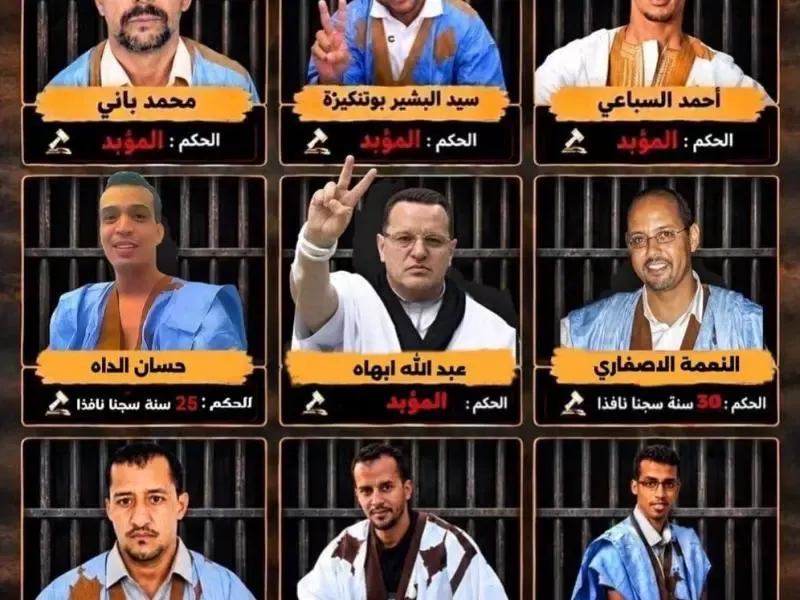
Nine Sahrawi prisoners from the "Gdeim Izik" group began an open-ended hunger strike on Wednesday, September 23, 2026, to protest the Moroccan occupation authorities' denial of their right to be transferred to cities in occupied Western Sahara. The prisoners, who have been detained for 16 years, said in a statement that this step is part of a long series of "hunger battles" they have waged inside Moroccan prisons to defend their rights and demands.
The prisoners' statement explained that the strike aims to force the Moroccan occupation state to implement UN treaty body decisions that have condemned it for systematic torture and arbitrary detention. These decisions include the opinion of the UN Working Group on Arbitrary Detention and the decisions of the Committee against Torture, which have exceeded eight. The prisoners also seek to expose what they describe as serious human rights violations against Sahrawi civilian prisoners in various Moroccan prisons.
The prisoners highlighted that they have been subjected to physical and psychological torture, long-term solitary confinement, denial of medical care and health services, and confiscation of their right to be transferred to cities in occupied Western Sahara. They called on the International Security Council to expand the legal mandate of the UN Mission for the Referendum in Western Sahara (MINURSO) to include monitoring human rights and documenting violations against Sahrawi civilians in the occupied part of the territory.
The prisoners also demanded that the International Committee of the Red Cross be allowed immediate and unconditional access to the territory to carry out its humanitarian tasks, including visiting prisons and detention centers and protecting civilians. The prisoners emphasized their determination to continue the strike "with all determination and perseverance" until they achieve their full rights.
The nine prisoners are distributed across three prisons: Mohamed Bani in Ait Melloul 2 prison; Abdullah Abahah, Mohamed Lamine Hadi, and Bashir Khuda in Tifelt 2 prison; and Sid El Bashir Boutenkiza, Ahmed Sebaai, Nema Asfari, Hussein Zawawi, and Hassan Dah in the Central Prison in Kenitra. They hold the Moroccan occupation state responsible for their physical and psychological safety.
The prisoners called on human rights and humanitarian organizations, as well as international community organizations, to intervene urgently to pressure the Moroccan authorities to respond to their demands. The prisoners concluded their statement with the slogan: "All Homeland or Martyrdom".
The prisoners' hunger strike is a protest against the Moroccan occupation authorities' continued denial of their rights, despite 16 years of arbitrary detention. The strike highlights the ongoing human rights situation in occupied Western Sahara and the need for international attention and action.
Key points
- Nine Sahrawi prisoners have started an open-ended hunger strike to protest their 16-year arbitrary detention and denial of rights.
- The prisoners are demanding implementation of UN treaty body decisions and an end to human rights violations against Sahrawi civilians.
- The hunger strike aims to pressure the Moroccan authorities to respond to the prisoners' demands and respect their rights.