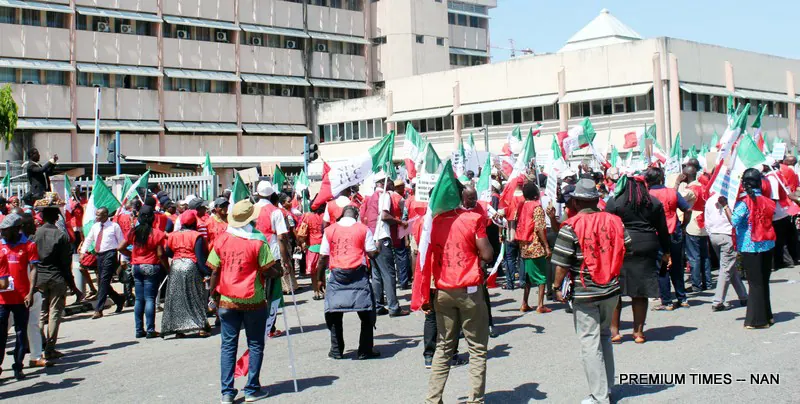
Nigerian workers, under the Joint National Public Service Negotiating Council (JNPSNC), have threatened to go on a three-day warning strike starting Friday over the high cost of petrol and the federal government's failure to review the national minimum wage. The council's National Secretary, Gbenga Olowoyo, stated this in a statement on Tuesday. The workers are demanding a reduction in petrol prices to at least ₦500 per litre and an increase in the minimum wage to cushion the effects of the rising cost of living.
The JNPSNC, comprising eight public-sector unions, including the Nigeria Civil Service Union and the Medical and Health Workers Union of Nigeria, is urging President Bola Tinubu to address the workers' demands in his national broadcast on Thursday, marking Nigeria's 66th Independence Day. If the government fails to take steps to address the demands by 30 September, the workers will have no option but to embark on the warning strike. The council's decision follows the government's failure to honour its demands after an earlier ultimatum expired on 30 September.
The minimum wage, currently ₦70,000, should be reviewed upward to cushion the economic hardship experienced by public workers, their dependants, and other vulnerable Nigerians. The council stated that the economic hardship occasioned by the high cost of fuel is placing the survival of Nigerian workers, their dependants, and the general populace under severe pressure, making it increasingly difficult for Nigerians to live normal and dignified lives.
The rising cost of petrol has contributed significantly to the economic hardship facing millions of households. Petrol prices have risen sharply since President Tinubu assumed office in May 2023 and announced the removal of the petrol subsidy. Before the subsidy was removed, petrol sold at about ₦195 per litre. The price rose sharply after the announcement, with the Nigerian National Petroleum Company Limited (NNPCL) initially increasing its pump prices to about ₦488–₦557 per litre in different parts of the country and subsequently to over ₦600 per litre.
The JNPSNC suggested that the government could reduce petrol prices by ensuring the sale of crude oil to the Dangote Refinery and operators of modular refineries on appropriate terms. This, the council believes, would facilitate increased domestic refining and help bring down the price of petroleum products. The council's National Secretary, Gbenga Olowoyo, urged the government to take urgent steps to address the workers' demands.
The increase in petrol prices has had far-reaching consequences beyond the cost of filling vehicles. Petrol is widely used for transportation and electricity generation, while businesses also rely on it to power generators and move goods and services. As fuel becomes more expensive, transport operators face higher operating costs and often transfer part of the additional cost to passengers through higher fares. Higher transportation costs also raise the cost of moving food and other goods from farms, factories, and markets to consumers.
The World Bank has linked the increase in gasoline prices following the subsidy removal to the cost-of-living pressures. It estimated that, without compensating measures, higher petrol prices could push about eight million additional Nigerians into poverty in the short term. The World Bank also noted that poor households are particularly vulnerable because they spend a large share of their income on food.
Key points
- The Nigerian workers' union is demanding a reduction in petrol prices to ₦500 per litre and an increase in the minimum wage.
- The warning strike may start on Friday if the government fails to address the workers' demands.
- The high cost of petrol has contributed significantly to the economic hardship facing millions of households in Nigeria.