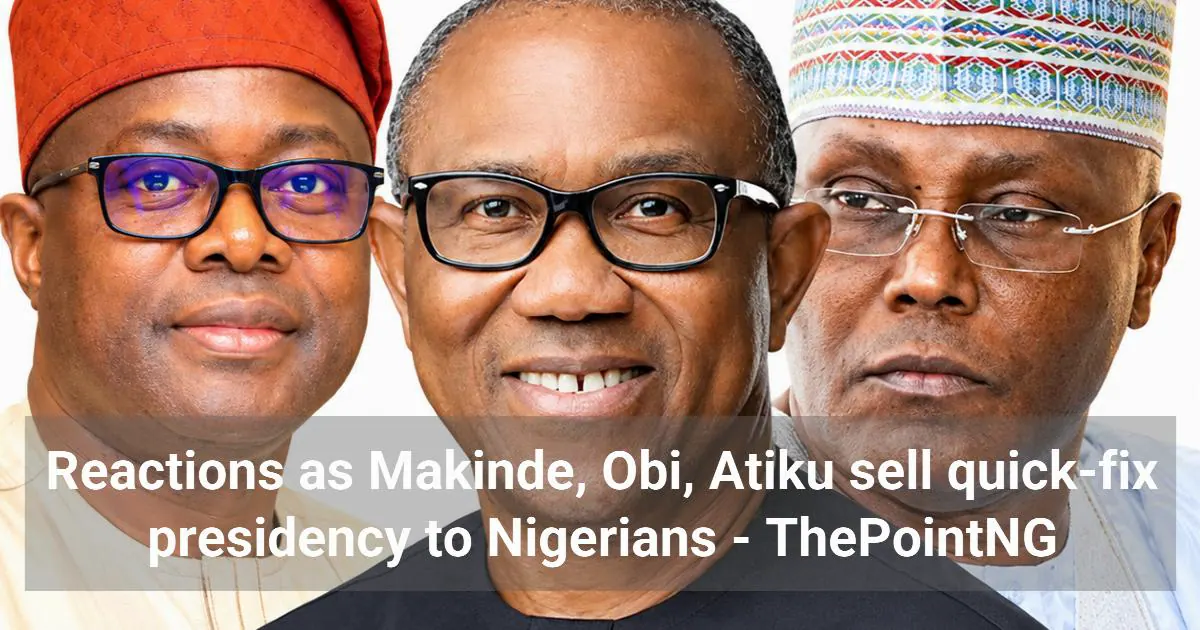
The race for the 2027 presidential election in Nigeria has gained momentum, with presidential hopefuls converging on a single campaign pitch - that the country's challenges can be fixed within four years. At town hall meetings across the country, candidates of the Allied People Movement, APM, the Nigeria Democratic Congress, NDC, and chieftains of the African Democratic Congress, ADC, insisted that one term is enough to reset the country. They outlined plans to address security, education, the economy, and the socio-political environment.
Seyi Makinde, the APM candidate and Governor of Oyo State, declared himself a "resetter" and promised to reset Nigeria within four years if elected. He explained that the reset agenda will cover security, education, the economy, and the socio-political environment. Makinde argued that the reset agenda can be concluded in four years, citing the example of a former head of state who ended military rule and ushered in democracy within 10 months.
Peter Obi, the NDC candidate, pledged to fix the economy and reinstate petroleum subsidy after tackling corruption. He insisted that corruption remains Nigeria's major challenge and promised to deploy resources to improve security, education, and infrastructure. Obi, who was in Sokoto for a town hall meeting, also promised to connect all state capitals with railway lines.
Senator Dino Melaye, a chieftain of the ADC, defended a similar subsidy-return plan, saying the party intends to make Nigeria affordable again by bringing back subsidy 100 percent. He claimed that the restoration will crash petrol from about N1,400 per litre to between N400 and N500. Melaye argued that what is currently described as subsidy removal is actually corruption and diversion of public wealth.
Makinde took a swipe at the current administration's handling of the economy and security, describing federal budgeting as "voodoo economics" and faulting the announcement of new army divisions without budgetary provision. He thanked Governor Abdullahi Sule for accommodating his team and promised special programmes for women in agriculture, market women, physically challenged women, and widows.
Obi and his running mate, Rabiu Kwankwaso, paid a courtesy visit to the Sultan of Sokoto, Alhaji Muhammad Sa'ad Abubakar III, who urged politicians to conduct their activities peacefully and avoid divisive rhetoric. The Sultan advised candidates to respect one another and uphold national unity, stressing that politics should not be a tool for dividing people.
The candidates' promises have been greeted with mixed reactions by Nigerians and public affairs analysts. They warned voters against taking the candidates' one-term promise hook, line, and sinker, calling for further interrogation of the quick fix. Analysts, including Jide Olufemi and Collins UGWU, expressed skepticism about the candidates' ability to fulfill their promises, citing past experiences with politicians.
Key points
- Presidential candidates in Nigeria promise to fix the country's challenges within four years.
- Candidates, including Seyi Makinde, Peter Obi, and Atiku Abubakar, outlined plans to address security, education, the economy, and the socio-political environment.
- Analysts have expressed skepticism about the candidates' ability to fulfill their promises, citing past experiences with politicians.